
What is Mindfulness-Based Stress Reduction (MBSR) ?
Everything you need to know
inding Your Anchor: A Simple Guide to Mindfulness-Based Stress Reduction (MBSR)
Welcome! If you’re exploring the world of therapy or looking for practical ways to manage stress, anxiety, or chronic pain, you’ve likely heard the term Mindfulness-Based Stress Reduction (MBSR). It sounds a bit technical, maybe a little intimidating, or perhaps just vague.
But at its heart, MBSR is incredibly simple and deeply human. It’s not about emptying your mind or becoming a monk. It’s about learning to pay attention to your life, right now, with kindness, so that you can navigate stress and difficult feelings with more clarity and less reactivity.
This article is for you—the everyday person, the “therapy customer”—who wants a clear, warm, and practical understanding of this powerful program.
Time to feel better. Find a mental, physical health expert that works for you.
What is MBSR, Really? The Origins
MBSR is essentially a highly structured, 8-week group program developed by Dr. Jon Kabat-Zinn in the late 1970s at the University of Massachusetts Medical School. He took ancient meditation and yoga practices and stripped away all the religious or spiritual aspects, creating a purely secular, evidence-based approach to help people manage stress, anxiety, and the impact of chronic illness. He initially designed the program for patients who weren’t responding well to traditional medical treatments for chronic conditions and severe pain.
The key word here is Mindfulness.
- Mindfulness is simply paying attention, on purpose, in the present moment, and non-judgmentally.
The core promise of MBSR is this: You can’t stop the waves of life (stress, worries, setbacks), but you can learn how to surf them. You learn to observe your thoughts and feelings without getting swept away by them.
The Foundation: Why We Need Mindfulness
To understand MBSR, we need to understand the default setting of the human mind—and why it often causes us so much stress.
- The Mind’s Time Machine and Automatic Pilot
Our brains are incredible at two things that often cause distress: predicting the future and reliving the past.
- Worry (The Future): We spend hours replaying hypothetical scenarios: What if I lose my job? What if I say the wrong thing? This generates anxiety.
- Ruminating (The Past): We replay old arguments or mistakes: I should have done this differently. Why did I say that? This generates regret, guilt, and sadness.
In both cases, you are physically sitting here, but your mind is somewhere else entirely. This constant mental time-travel is the engine of stress.
Furthermore, we often operate on Automatic Pilot. This is when we move through our day doing things out of habit, without conscious awareness. We eat meals while looking at a screen, drive to work without remembering the turns, and snap at a loved one before realizing we did it. MBSR teaches you to recognize when your attention has drifted and gently steer it back to the reality of the present moment.
- The Habit of Reactivity
When stress hits, most of us fall into a reactionary cycle, often called the “fight or flight” response.
- Situation: Your boss sends a sharp email.
- Physical Response: Your body starts to feel tense—your shoulders tighten, your breath quickens (A physical symptom).
- Automatic Thought/Judgment: Your mind immediately judges this feeling (“Oh no, I hate this feeling! I need to stop this feeling right now! This is too much.”).
- Escalation: The fear of the feeling and the fight against it actually increases the intensity of the feeling and the resulting stress. Your nervous system is flooded.
MBSR teaches you how to step out of this automatic, escalating loop. It teaches you to respond rather than react. By observing the physical symptoms of stress and the critical thoughts that follow, you create a space to choose a wiser action.
The Three Core Practices of MBSR
MBSR is not theory; it’s practice. The 8-week course is focused on systematically integrating three main tools into your life. You learn these tools in a structured sequence, building your mental muscle week by week.
- The Body Scan: Anchoring in Physical Sensation
The Body Scan is typically the first major practice you learn. It’s a foundational exercise where you bring focused, gentle attention to every part of your body, usually lying down.
- What you do: Starting with your toes, you mentally move your awareness slowly upward—to your feet, ankles, calves, knees, and so on—all the way to the top of your head. The instruction is to simply feel whatever sensations are present in that area.
- The Goal: The purpose is not to relax (though that often happens). The true goal is to feel sensations—pressure, warmth, tingling, tightness, or discomfort—without judgment or trying to change them.
- The Lesson: This practice teaches you to become intimately familiar with the language of your body. Since stress and anxiety often manifest as physical symptoms (tight stomach, rapid heart rate), learning to observe them calmly is the first step in disarming them. It gets you out of your overthinking mind and firmly into the present moment of your physical body. It’s an exercise in pure observation.
- Mindful Movement (Gentle Yoga): Presence in Action
MBSR incorporates simple, gentle yoga and stretching movements. You do not need to be flexible, strong, or experienced. The movements are merely a vehicle for mindfulness.
- What you do: You move slowly, coordinating your movement with your breath. You notice the sensation of stretching and relaxing muscles. If a movement causes discomfort, you practice finding the boundary of that discomfort and gently pausing, breathing into it.
- The Goal: To practice mindfulness while doing something. Our daily lives are all about doing, so this practice helps bridge the gap between sitting meditation and active life. You learn to notice when your mind wanders off into planning or worrying, and you gently bring it back to the feeling of the breath and the body moving.
- The Lesson: This teaches you the concept of “taking care” rather than “fixing.” If a stretch feels tight, you simply notice the sensation and breathe with it, rather than forcing it or judging your lack of flexibility. This same compassionate approach can then be applied to your emotional discomfort: you learn to sit with an unpleasant feeling without trying to immediately change or escape it.
- Sitting Meditation: Working with Thoughts and Emotions
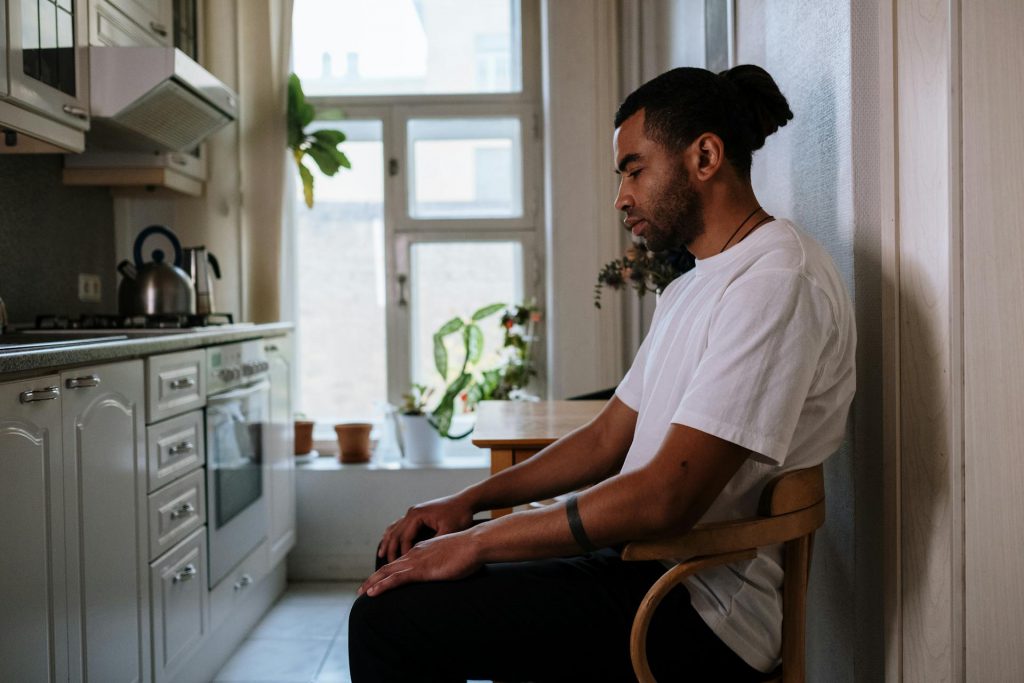
This is often the most challenging, yet most profound, practice. Here, you sit comfortably and use three primary anchors to stay present:
Connect Free. Improve your mental and physical health with a professional near you
- Anchor on the Breath
You choose a spot (like your belly, chest, or nostrils) and feel the simple, repetitive in-and-out of the breath. The breath is always in the present moment, making it the perfect anchor. Whenever your mind inevitably wanders—to a worry, a memory, or an urge—you gently recognize the thought and return your full attention to the feeling of the breath.
- Working with Thoughts (Clouds in the Sky)
When a thought comes up—a worry, a memory, a to-do list item—MBSR teaches you to label it (e.g., “Oh, that’s planning” or “That’s worrying”). The key is to see the thought as a mental event, not as a command or a fact. You observe it simply as electrical activity in the brain. You watch it pass by, like a cloud in the sky, without having to jump onto it and ride it away. This fundamentally changes the power your thoughts have over your mood.
- Working with Difficult Emotions (Turning Towards)
When a difficult emotion arises (sadness, anger, fear), the natural impulse is to push it away. MBSR encourages “turning towards” it. You notice where the emotion is manifesting in your body (tight chest, lump in throat) and you stay present with the physical sensation, breathing with it, without weaving a narrative around it. This radical, non-judgmental acceptance often reduces the emotion’s intensity and helps it dissipate, proving that discomfort is not inherently dangerous.
The Attitude of MBSR: Radical Acceptance and Kindness
The practices of MBSR are only as powerful as the attitude you bring to them. Dr. Kabat-Zinn emphasizes seven key attitudes that underpin the entire program. These are the “how” of mindfulness:
- Non-Judging: The most important one. When your mind wanders for the hundredth time, the practice isn’t to judge yourself; it’s to notice, “Ah, my mind wandered,” and gently begin again. This self-compassion is key to breaking critical internal cycles.
- Patience: Recognizing that change and things unfold in their own time. You can’t rush growth, or force relaxation.
- Beginner’s Mind: Seeing the world, the moment, or even your own feelings as if for the very first time. This breaks stale habits of perception and allows for discovery.
- Trust: Trusting yourself, your body, and your intuition to guide you. Trusting the process itself.
- Non-Striving: You are not trying to get anywhere or achieve a certain state (like perfect stillness). You are only trying to be present where you are, even if where you are is restless or anxious.
- Acceptance: Seeing things as they are, in this moment, not how you wish they were. Acceptance is not resignation; it is simply acknowledging the current reality so you can work with it effectively.
- Letting Go: Allowing thoughts, feelings, and sensations to come and go without clinging to the pleasant ones or pushing away the unpleasant ones.
These attitudes are the foundation of self-compassion, which is vital for reducing stress and emotional pain.
The 8-Week Structure: A Transformative Journey
MBSR is offered as a standardized 8-week course, which usually includes a full-day, silent retreat between weeks six and seven. This structure is intentional and helps build momentum and consistency.
Week Focus | Core Theme & Skill Development |
|---|---|
Week 1 | Introduction to Automatic Pilot. Awareness of how often we act without conscious attention. Introduction to the Raisin Exercise (mindful eating) and the Body Scan. |
Week 2 | Dealing with Obstacles. Understanding that difficulties (restlessness, boredom, sleepiness) are part of the practice. Deepening the Body Scan. |
Week 3 | Mindfulness of the Breath and Body in Movement. Practicing gentle yoga and using the breath as the primary anchor for attention. |
Week 4 | Staying Present. Bringing mindfulness into daily activities. Deepening seated meditation and recognizing when the mind wanders. |
Week 5 | Working with Difficulties. Learning how to “turn toward” emotional and physical discomfort rather than habitually avoiding it (The “A.R.T. of Acceptance”). |
Week 6 | Emotions are Not Facts. Exploring thoughts as mental events (the “clouds in the sky” metaphor) and understanding how our perception shapes our reality. Focus on self-compassion. |
Week 7 | The Full-Day Retreat. A chance to dedicate an entire day to silent practice, cementing the skills learned and integrating them deeply. |
Week 8 | Bringing Mindfulness into Your Life. Discussing relapse prevention, maintenance, and integrating the formal practices into informal daily living (e.g., mindful dishwashing, walking, or listening). |
This systematic approach is what makes MBSR so effective. You aren’t just learning a few random techniques; you are retraining your nervous system and changing your relationship with stress over a sustained period. The consistency of the 8-week framework is key to fostering new neural pathways in the brain that support greater calm and resilience.
The True Benefit: A Shift in Being
The biggest change promised by MBSR is not the elimination of stress—that’s impossible. The true benefit is a deep, fundamental shift in how you inhabit your life.
- From Automatic to Intentional: You move from constantly being on “automatic pilot” (where habits and old patterns run the show) to making intentional, conscious choices moment by moment.
- From Fighting to Allowing: You stop fighting your inner experience (anxiety, sadness, pain) and start allowing it to be there, which paradoxically lessens its hold on you and reduces the secondary stress caused by avoidance.
- From Reacting to Responding: When faced with a difficult situation, you gain the space to choose your action, rather than just instinctively reacting from a place of panic or anger. This pause allows your prefrontal cortex (the thinking part of your brain) to engage, rather than defaulting to the amygdala (the emotional/fear center).
This ability to pause, observe, and choose your response is the ultimate antidote to stress and the central gift of Mindfulness-Based Stress Reduction. It empowers you to navigate the inevitable challenges of life with greater stability, wisdom, and compassion for yourself.

Free consultations. Connect free with local health professionals near you.
Conclusion
Wrapping Up Your Journey: The Enduring Gift of Mindfulness-Based Stress Reduction (MBSR)
If you have completed an 8-week program in Mindfulness-Based Stress Reduction (MBSR), or have simply absorbed its core concepts, you have accomplished something truly significant: you have fundamentally changed your relationship with stress, pain, and life itself. The conclusion of the formal program is not a finish line, but a graduation—an invitation to step fully into the role of being the conscious, non-judgmental observer of your own life.
This conclusion is about understanding that the meditation mat and the yoga studio were the training ground, but the real practice begins and continues in the messy, wonderful details of your everyday existence: in traffic jams, during difficult conversations, and in moments of quiet contemplation.
The True Outcome: Changing Your Relationship with Experience
The most profound realization from MBSR is that stress is not a thing that happens to you; stress is your reaction to what happens. Dr. Jon Kabat-Zinn often emphasizes that you cannot stop the waves, but you can learn to surf. This metaphor captures the heart of the MBSR conclusion.
- Before MBSR: When a “wave” (a setback, an anxious feeling) hit, your automatic response was usually to panic, fight it, or run away (the “fight or flight” reaction). This secondary reaction often created more pain than the original event.
- After MBSR: When a wave hits, you now have the skill to pause. You can use your breath as an anchor to remain present. You can observe the wave (the physical sensation of anxiety, the rush of a critical thought) without judgment, without clinging, and without automatically reacting. You learn that the anxiety is a feeling, not a prophecy, and it will eventually pass.
This capacity to respond rather than react is the enduring gift of the program. It provides you with psychological space where previously there was only automatic, overwhelming habit.
The Enduring Power of the MBSR Practices
As you move beyond the structure of the 8 weeks, the core practices cease to be “exercises” and evolve into reliable tools for self-regulation and well-being.
- Daily Formal Practice: The Anchor that Holds
The biggest mistake after completing MBSR is stopping the formal practice (Body Scan, Sitting Meditation, Mindful Movement). While the time commitment may shift, consistency is paramount for maintenance.
- The Body Scan: This remains your primary tool for grounding. In moments of high stress or emotional overwhelm, a quick, conscious scan of the body—noticing tension in the shoulders or stomach—can pull your awareness out of a mental spiral and into the physical present moment. This skill prevents stress from becoming completely disembodied and overwhelming.
- Sitting Meditation: This practice continues to train your non-striving and non-judgmental mind. Even ten minutes a day is enough to maintain the capacity to see thoughts as “clouds in the sky”—as passing mental events—rather than as facts you must obey. This distance from your thoughts is key to emotional stability.
- Mindful Movement: The gentle yoga practices are crucial for integrating mindfulness with the physical experience of life. They remind you that the principle of “turning toward” discomfort with kindness applies to your body, your emotions, and your relationships.
- Informal Mindfulness: Weaving Awareness into Life
The true success of MBSR is measured by how seamlessly you weave awareness into your daily life—this is informal mindfulness.
- Mindful Transitions: Paying attention when you move between tasks—walking from the car to the house, transitioning from work to dinner, or opening a door. This simple act breaks the chain of automatic pilot.
- Mindful Communication: When engaged in a conversation, paying complete attention to the person speaking (not planning your reply). When listening, you are fully present, anchored by the sound of their voice. This practice radically improves connection and reduces relational stress.
- Mindful Consumption: Truly tasting your food, feeling the water in the shower, or focusing on the smell of your morning coffee. These small acts of presence reclaim moments of pleasure and gratitude that are usually swallowed by preoccupation.
The ultimate conclusion is that life itself becomes your practice.
Planning for Challenges: Relapse and The Attitude of Kindness
A common question at the end of MBSR is, “What happens when I fall back into my old ways?”
In the context of mindfulness, a relapse is not a failure; it is merely a moment when you return to automatic pilot. It is an opportunity to practice self-compassion and non-judgment—the very attitudes you spent 8 weeks cultivating.
The Power of “Just Noticing”
The critical skill in relapse prevention is Just Noticing your decline before it spirals out of control. Your therapist or instructor would have encouraged you to identify your personal warning signs (e.g., increased phone scrolling, difficulty sleeping, snapping at loved ones).
When you notice a warning sign, you have two choices:
- Old Habit (Reaction): Judge yourself (“I failed! I’m back where I started!”), which adds a layer of distress and shame to the existing problem.
- MBSR Skill (Response): Pause, name the experience (“Ah, this is the feeling of anxiety and the thought of self-criticism”), and immediately return to your anchor (the breath, the body).
This response is an act of deep kindness. It stops the secondary suffering—the stress caused by judging your stress—and allows you to step back into a place of conscious choice.
Integrating the Seven Attitudes
At the conclusion of the program, the seven attitudes of MBSR become your ethical compass for navigating life’s difficulties:
- When you feel frustrated by slow progress, you apply Patience.
- When your inner critic starts shouting, you apply Non-Judgment and Trust.
- When life is messy and you wish things were different, you practice Acceptance—seeing reality clearly so you know how to move forward.
The ultimate conclusion of MBSR is the realization that you have everything you need to meet the challenges of life with wisdom and resilience, because you are no longer locked in combat with yourself. You have found your anchor, and it resides within you, accessible in every breath.
Time to feel better. Find a mental, physical health expert that works for you.
Common FAQs
If you’ve read about the 8-week MBSR program, you likely have specific questions about what the practice feels like, how it fits into a busy life, and what its limits are. Here are answers to some of the most frequently asked questions from people considering or starting MBSR.
Is MBSR the same as meditation?
No, but meditation is the primary tool of MBSR.
- Meditation is the act of focused training of attention and awareness, which is often done sitting quietly. There are many types of meditation (concentration, loving-kindness, insight, etc.).
- MBSR is a specific, structured, 8-week curriculum that uses three core meditation techniques (Body Scan, Sitting Meditation, and Mindful Movement) to specifically address stress, illness, and pain.
- It’s a secular (non-religious) program designed to be practical and evidence-based. It teaches you the why and the how of mindfulness, focusing on the attitudes like non-judgment and acceptance.
Do I have to stop my mind from thinking during meditation?
Absolutely not! This is the most common misunderstanding and the biggest reason people give up on meditation.
- The Goal is Not a Blank Mind: Your brain’s job is to think; it’s like a thought factory. Trying to stop thinking is impossible and just creates more frustration.
- The Goal is Awareness: In MBSR, the goal is simply to notice when your mind has started thinking or wandering, and then gently bring your attention back to your anchor (usually the breath).
- The Practice: Every time you notice your mind has wandered and you bring it back, that is a successful moment of mindfulness. It’s a repetition of training your attention muscle, not achieving silence.
How much time do I have to commit to MBSR?
The structured program requires a significant commitment for eight weeks, but this commitment is what drives lasting change.
- In-Class Time: You will meet with the group and instructor for one session per week, often 2 to 2.5 hours long.
- Home Practice: The most crucial element is the daily homework. You are typically asked to practice formally for 45–60 minutes per day (using guided recordings for the Body Scan or sitting meditation) and engage in informal mindfulness throughout the day.
- The Full Day: The program also includes a mandatory full-day (usually silent) retreat between weeks six and seven.
It’s important to treat the home practice like an appointment you cannot miss, as this sustained effort is what retrains your nervous system.
Can MBSR help with anxiety and panic attacks?
Yes, MBSR is highly effective for managing anxiety and panic. The core skills directly target the mechanisms that fuel anxiety.
- Breaking the Cycle: Anxiety and panic thrive on the fight-or-flight response and the thought that the feeling itself is dangerous. MBSR teaches you to observe the physical symptoms of anxiety (tight chest, rapid heart) non-judgmentally.
- Turning Toward: Instead of fighting the feeling (which escalates it), you learn to “turn toward” the discomfort, stay anchored in your breath, and let the wave of panic crest and pass. This teaches the nervous system that intense feelings are tolerable and not catastrophic, reducing the fear of the next attack.
Do I need to be flexible or spiritual to do MBSR?
No to both!
- Flexibility: The gentle yoga and mindful movement exercises are adapted for all body types and physical limitations. If you can’t get on the floor, you can do them sitting. The purpose is not physical fitness, but using movement as a tool for attention.
- Spirituality: MBSR is entirely secular and rooted in medical science. It doesn’t require any belief system. While the practices originate from Eastern traditions, they are taught as mental health techniques, much like how breathing exercises are used in physical therapy.
What if I find the Body Scan or meditation boring or restless?
The feeling of boredom, impatience, or restlessness is the practice. It’s not an obstacle; it’s the material you are working with.
- Mindfulness of Boredom: When your mind says, “This is boring, I should stop,” the MBSR approach is to notice the thought “I’m bored” and the feeling of restlessness in your body, and then gently return to the breath.
- Acceptance of Discomfort: MBSR teaches you that resistance to an experience (like boredom or restlessness) is what creates suffering. By practicing non-judgmental awareness of the discomfort, you lessen its hold on you. The goal is to tolerate the experience, not eliminate it.
Does MBSR replace traditional therapy or medication?
For many people, MBSR is a powerful complement, but it’s rarely a replacement for primary treatments.
- Complementary Tool: MBSR is fantastic for stress reduction, managing anxiety symptoms, and coping with chronic pain. It can enhance the effectiveness of Cognitive Behavioral Therapy (CBT) by teaching you how to step away from distressing thoughts rather than just challenging them.
- Consult Your Doctor: If you are taking medication or are in therapy for a serious mental health condition, you should always consult your healthcare provider before starting MBSR. It is a powerful practice, but it works best as part of a comprehensive care plan.
What is the difference between formal and informal practice?
- Formal Practice: This is the scheduled, dedicated time you set aside for the core techniques: the Body Scan, Sitting Meditation, or Mindful Movement. It’s the daily “training session.”
- Informal Practice: This is the conscious effort to bring mindfulness to everyday activities. Examples include:
- Mindful Eating: Paying full attention to the taste and texture of your meal.
- Mindful Walking: Focusing on the sensations of your feet touching the ground.
- Mindful Listening: Giving complete, non-judgmental attention to someone speaking.
Informal practice is where the lessons learned on the mat truly integrate into your life, ensuring the benefits are felt moment-to-moment.
People also ask
Q: What is an anchor in mindfulness?
A: If you want to focus on your body, a good mindfulness anchor would be the sound and movement of your breathing, in and out. If you want to focus on your environment, consider lighting a candle or sticks of incense. Common examples of mindfulness anchors include: Breathing.
Q:What is mindfulness-based stress reduction (MBSR)?
A: Background: Mindfulness Based Stress Reduction (MBSR) therapy is a meditation therapy, though originally designed for stress management, it is being used for treating a variety of illnesses such as depression, anxiety, chronic pain, cancer, diabetes mellitus, hypertension, skin and immune disorders.
Q: What is the main purpose of mindfulness?
A: It is a type of meditation in which you focus on your thoughts, feelings, body and surroundings. You do this without judgment. There’s only awareness of the moment as it is. Research has shown that mindfulness can support both mental and physical well-being.
Q:What is the meaning of ⚓?
A: Anchor Emoji: Symbolizing Stability, Strength, and Adventure in Nautical-themed Jewelry. The ⚓ anchor emoji is a symbol that represents nautical-themed jewelry. It is often associated with images of ships, sailors, and the sea. This emoji is commonly used to convey a sense of stability, strength, and adventure.Jul 13, 2023
NOTICE TO USERS
MindBodyToday is not intended to be a substitute for professional advice, diagnosis, medical treatment, or therapy. Always seek the advice of your physician or qualified mental health provider with any questions you may have regarding any mental health symptom or medical condition. Never disregard professional psychological or medical advice nor delay in seeking professional advice or treatment because of something you have read on MindBodyToday.
Share this article

Let us know about your needs

Quickly reach the right healthcare Pro

Message health care pros and get the help you need.
Popular Healthcare Professionals Near You
You might also like

What is Face Your Fear and…
, What is Exposure Therapy for Anxiety? Everything you need to know Find a Pro Facing the Fear Monster: A […]

What is Psychodynamic Therapy Explained Guide?
, What is Psychodynamic Therapy Principles? Everything you need to know Find a Pro Digging Deeper: A Simple Guide to […]

What is DBT Therapy Made Simple…
, What is Dialectical Behavior Therapy (DBT) ? Everything you need to know Find a Pro Navigating the Storm: Understanding […]

