
What is Attachment Theory in Therapy ?
Everything you need to know
Finding Security: How Attachment Theory Shapes Your Life and Your Therapy
If you’re considering or already engaged in therapy, you’re on a journey of profound self-discovery. You’ve likely explored your feelings, your thoughts, and your behaviors. But there’s another critical piece of the puzzle that often explains why you think, feel, and act the way you do in relationships: Attachment Theory.
Attachment theory is one of the most powerful concepts in modern psychology, yet it can sound intimidatingly academic. In reality, it offers a simple, comforting, and deeply practical explanation for why some of us find connection easy, why others struggle with trust, and why others feel overwhelmed by intimacy.
This article is written just for you—the everyday person seeking understanding. We’ll break down attachment theory, explore your attachment style, and most importantly, show you how understanding it can transform your relationships and make your therapy journey more effective and meaningful.
Time to feel better. Find a mental, physical health expert that works for you.
What is Attachment Theory, Anyway?
At its heart, attachment theory is incredibly simple: Humans are wired for connection. We need secure, reliable bonds with others to survive and thrive. This need doesn’t go away when we become adults; it just shifts focus from our parents to our romantic partners, close friends, and even our therapist.
The Foundation: Early Life and the Secure Base
Attachment theory began with psychiatrist John Bowlby and psychologist Mary Ainsworth in the mid-20th century. Bowlby proposed that infants come into the world equipped with a biological system—the attachment system—that motivates them to seek closeness to a primary caregiver (usually a parent) when they are distressed or threatened.
The primary job of the caregiver is to be a secure base and a safe haven:
- Safe Haven: When the baby is scared, hurt, or distressed, they run to the caregiver for comfort and protection. This shuts down the baby’s alarm system.
- Secure Base: When the baby feels safe, they use the caregiver as a base from which to explore the world, knowing they can always return if needed.
The consistent way your early caregivers responded to your needs—were they warm and available, or dismissive and unpredictable? —created an Internal Working Model (IWM) of relationships in your young mind. This IWM is essentially a set of unconscious rules about:
- Self-Worth:Am I worthy of love and care?
- Trust:Are others reliable and available when I need them?
This unconscious model is the lens through which you view every subsequent relationship, influencing everything from how you ask for a favor to how you react to a partner forgetting your birthday.
The Four Main Attachment Styles
Based on decades of research, psychologists have identified four main attachment styles that we carry from childhood into adulthood. Understanding your style isn’t about labeling yourself; it’s about gaining self-awareness and recognizing the patterns that play out automatically when your attachment system is activated (usually during stress or conflict).
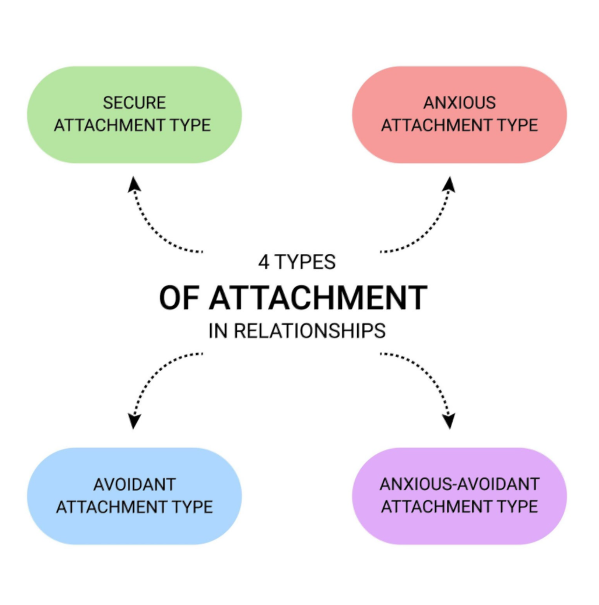
-
The Secure Style (The Anchor)
If you’re secure, you likely had caregivers who were consistently sensitive and responsive to your needs most of the time. They were available when you needed them but also encouraged your independence.
How it Looks in Adulthood:
- Comfortable with intimacy and independence: You enjoy closeness but are also fine spending time alone without excessive worry.
- Good at communication: You express your needs and feelings clearly and directly without resorting to games or withdrawal.
- Trusting: You trust that your partner loves you and will be there for you. You don’t get overly worried when they need space or are busy.
- Conflict: You handle conflict well, seeing it as a temporary problem to be solved together, not a threat to the relationship.
The Internal Working Model: “I am lovable, and people are generally reliable.”
Connect Free. Improve your mental and physical health with a professional near you

-
The Anxious-Preoccupied Style (The Seeker)
This style typically develops when caregivers were sometimes available and loving, but sometimes inconsistent, distracted, or intrusive. This creates an anxious uncertainty: Will they be there for me this time? Because the need was met sometimes, the child learned to heighten their distress to get attention.
How it Looks in Adulthood:
- Craves intimacy, but lives in fear: You desire a lot of closeness but worry constantly about your partner’s love and availability.
- “Activated” easily: Your attachment system triggers quickly (high alarm), leading to fear of abandonment, jealousy, or insecurity.
- Protest Behaviors: When feeling insecure, you engage in behaviors to get a reaction or force closeness: excessive texting, withdrawing to punish, trying to make the partner jealous, or picking a fight to “test” the relationship.
- Focus on the partner: You often put your focus and energy on the relationship, sometimes at the expense of your own interests or well-being.
The Internal Working Model: “I am unsure if I am lovable, but maybe if I cling hard enough, they will stay.”
-
The Dismissive-Avoidant Style (The Lone Wolf)
This style develops when caregivers were consistently unavailable, unresponsive, or uncomfortable with emotional expression. The child learns that expressing needs won’t help and might even push the caregiver further away. To cope, the system “deactivates” or shuts down the need for connection, prioritizing self-sufficiency.
How it Looks in Adulthood:
- Values independence fiercely: You prioritize self-reliance and view needing others as a weakness or burden.
- Uncomfortable with closeness: When relationships get serious or emotionally intense, you feel suffocated and look for ways to create distance (finding flaws in the partner, focusing on work, suddenly pulling away).
- “Deactivating” strategies: You use mental or physical strategies to suppress emotional needs and minimize the importance of the relationship. You might intellectualize feelings or focus on past partners who were “better.”
- Difficulty expressing feelings: You struggle to identify or communicate deep emotions, preferring rationality.
The Internal Working Model: “I am strong and self-reliant, but people can’t be trusted to meet my needs.”
-
The Fearful-Avoidant / Disorganized Style (The Roller Coaster)
This style is the most complex and often develops from a history of confusing, frightening, or traumatic experiences with caregivers. The source of comfort (the caregiver) is also the source of fear. There is no consistent strategy, leading to chaotic emotional reactions.
How it Looks in Adulthood:
- Mix of Anxious and Avoidant: You desperately crave intimacy (high need for closeness) but are terrified of it (high fear of vulnerability).
- Pushes/Pulls: You get close, feel overwhelmed, and then push the partner away, only to regret the distance and pull them back in later.
- High Conflict: Relationships are characterized by dramatic “on again, off again” cycles.
- Struggles with regulation: You often struggle to manage intense emotions and feel chaotic internally because the two opposing needs (to connect and to flee) are constantly in conflict.
The Internal Working Model: “I want to be close, but closeness always leads to pain. People are dangerous.”
Attachment Theory in the Therapy Room
So, how does knowing all this help you in therapy? Tremendously! The relationship with your therapist—the therapeutic relationship—is a powerful opportunity for change.
-
Understanding Transference and the Safe Haven
The moment you walk into the therapy room; your attachment system is active. You will unconsciously relate to your therapist based on your IWM. This is called transference.
Your therapist is trained to recognize these patterns. They are intentionally acting as a New Secure Base and Safe Haven to challenge your old model. They offer consistent availability and emotional containment, which is the opposite of the inconsistent or dismissive responses you might have experienced early on.
-
The Corrective Emotional Experience
The core goal of attachment-based therapy is to provide a Corrective Emotional Experience (CEE). This happens when the therapist consistently offers you the reliable, safe response that your original caregivers couldn’t or didn’t provide.
For example, when you, the client, express deep emotion, and the therapist responds with patience, validation, and acceptance, your unconscious mind gets an update. It learns: “When I show my true feelings, I am met with safety, not withdrawal or criticism.”
By consistently experiencing this security and availability, you slowly, session by session, start to update your IWM. Your unconscious mind begins to learn: “This person is safe. Maybe people can be reliable. Maybe my needs are okay.”
-
Repairing Ruptures: The Power of Mistakes
Sometimes, the most powerful healing moment happens when the therapist makes a mistake (a rupture) and then sincerely repairs it.
In real relationships, conflicts and missteps happen. For someone with an insecure attachment style, a therapist’s misstep can trigger old pain: “Aha! I knew they would let me down!”
The therapeutic magic happens when the therapist:
- Notices the rupture and gently asks about it.
- Takes responsibility (“I apologize. I misheard you, and I can see how that felt invalidating. That wasn’t my intention.”)
- Recommits (“I value our work, and I want to make sure you feel safe here.”)
This repair process is profoundly corrective. It teaches the client that conflict doesn’t have to mean abandonment or catastrophic loss. It teaches that relationships can survive mistakes, and that vulnerability is okay because the partner (the therapist) will show up and repair the connection.

Free consultations. Connect free with local health professionals near you.
Conclusion
The Bottom Line: Earning Security
It is absolutely vital to know that your attachment style is not a life sentence. It is a strategy—a set of coping mechanisms you developed in childhood based on your earliest environment. And because it’s a strategy, it can be updated and changed through new, secure relationships, chief among them, the therapeutic relationship.
The journey through attachment-based therapy is often called earning security. It means actively working to develop the reliability, compassion, and awareness of a secure person, both in your relationships and, most importantly, with yourself.
By understanding how your early needs were met (or unmet), you can stop blaming yourself or your partner for relationship struggles and start building the foundation for deeper, healthier, and more satisfying connections. This knowledge is your roadmap to finding stability, trust, and genuine intimacy.
The Bottom Line: Your Journey to Earning Security
If you’ve come this far in understanding Attachment Theory, you’ve taken a massive step toward self-compassion and clearer relationships. You’ve recognized that the way you love, fear, connect, and withdraw isn’t a random flaw; it’s a brilliant strategy—a survival mechanism developed in childhood to cope with the environment you were given.
This conclusion focuses on the enduring message of hope and agency: Your attachment style is not a life sentence. It is a set of learned patterns that can be updated, softened, and ultimately transformed through conscious effort and corrective experiences. This journey is often called “Earning Security.”
Embracing the Reality of “Earning Security”
The concept of “earning security” is powerful because it emphasizes that this transformation is an active process, not a passive one. You don’t wait for a perfect partner or a flawless therapist to magically fix you; you actively engage in the work of becoming your own secure base.
Earning security means internalizing the two core components of the secure style:
- Positive Self-View: Believing, deep down, that you are worthy of love, care, and attention. You are inherently valuable.
- Positive View of Others: Recognizing that others are generally reliable, that mistakes don’t mean abandonment, and that expressing vulnerability is usually safe.
This process happens slowly, fueled by the consistent, small actions you take in and out of therapy.
The Role of Self-Compassion in Healing
When you recognize that your attachment patterns (like anxious demanding or avoidant withdrawal) were once necessary survival strategies, it allows you to move away from shame and self-blame.
- Instead of: “I’m so needy and dramatic. Why can’t I just be normal?” (Shame)
- You can say: “My anxiety is spiking because my alarm system is activated. I learned a long time ago that I had to protest loudly to get noticed. That strategy kept me safe then, but I don’t need it now. I can gently soothe this feeling.” (Self-Compassion and Awareness)
This compassionate lens is the oil that allows the engine of change to run smoothly. You stop fighting yourself and start seeing your patterns as data—information you can use to choose a different response next time. The first person you need to offer a secure, validating relationship to is yourself.
The Enduring Gift of the Therapeutic Relationship
Your therapist’s office is your primary laboratory for earning security. The therapeutic relationship is unique because it offers a contained, consistent, and predictable environment where the rules of your IWM can be safely broken.
Think about the repetitive nature of the corrective experience:
- For the Anxious Client: They repeatedly test the therapist by worrying, needing reassurance, or apologizing excessively. The therapist’s consistent response is non-judgmental stability. This teaches the client: I can be my messy, imperfect self, and this person will still be here. This slowly cools down the hyper-vigilance of the anxious system.
- For the Avoidant Client: They repeatedly intellectualize, withdraw emotionally, or dismiss the therapy process. The therapist’s consistent response is gentle patience and the creation of space for vulnerability. This teaches the client: I can have a deep need for connection, and it won’t be overwhelming. I don’t have to defend myself or run away. This slowly reactivates the dormant attachment system.
The healing is not in the advice; it’s in the relational experience. The fact that you survived the fear, stayed in the room, and were met with acceptance is the most powerful evidence your brain will ever receive that security is possible.
Practical Steps for Long-Term Security
Earning security is a practice, not a destination. Once you leave the focused period of therapy, here are three ways to continue integrating secure patterns into your life:
1. Practice “Self-Repair” After Conflict
In secure relationships, conflicts happen, but they are followed by repair. When you have a fight or a misunderstanding with your partner, don’t rush to blame or withdraw. Instead, apply the principles of the corrective experience to yourself:
- Pause and Acknowledge: “I reacted out of fear (my anxious/avoidant strategy). That was my old pattern showing up.”
- Take Responsibility (for your part): Calmly apologize for the impact of your reaction (“I’m sorry I shut down and walked away; that was hurtful.”)
- Recommit: Re-engage with the partner from a place of secure honesty (“I still want to talk about this, but I’m going to take a moment to regulate my breathing first.”)
This practice teaches your nervous system that you are now the stable adult who can manage distress and maintain connection, even after a rupture.
2. Seek Out Secure Relationships
While your partner doesn’t have to be perfectly secure to have a healthy relationship, actively choosing friends and partners who are emotionally mature and consistent is vital. Secure people provide natural corrective experiences just by being themselves. They show you, through their consistent behavior, that:
- Needs are normal.
- Feelings are manageable.
- Conflict can be resolved without catastrophe.
Surrounding yourself with secure attachments acts as a daily maintenance plan for your own earned security.
3. Prioritize Vulnerability Over Strategy
This is the hardest and most important step. For an insecure person, expressing a real, vulnerable need feels terrifying because it contradicts the IWM.
- Anxious strategy is to manipulate a connection (protest behavior).
- Avoidant strategy is to deny the need (deactivating strategy).
Earning security means catching the strategy and choosing vulnerability instead.
- Instead of the anxious protest, say: “I feel scared right now that you’re pulling away. I really need to hear that we’re okay.”
- Instead of the avoidant withdrawal, say: “I feel overwhelmed, and my instinct is to run, but I’m trying to stay. Can we just sit here quietly for a minute?”
Choosing vulnerability—even when your system screams danger—is the definitive action that proves your IWM wrong and solidifies your secure status.
In conclusion, understanding Attachment Theory is your invitation to rewrite your relational script. It moves you from being a passive participant in your relationship patterns to an active architect of secure, fulfilling connections. The work is challenging, but the result—a deep, unshakable sense of inner security—is the most valuable gift you can ever give yourself.
Time to feel better. Find a mental, physical health expert that works for you.
Common FAQs
Since you’ve learned about the four attachment styles and how they influence your life, you probably have some practical questions about what this means for your therapy and your relationships. Here are some of the most common questions people ask when exploring Attachment Theory:
Can my adult attachment style change?
Absolutely, yes! This is one of the most hopeful and important takeaways. Your attachment style is not a fixed personality trait; it’s a set of learned strategies your brain uses to seek safety and connection.
While your childhood attachment style (developed with caregivers) is stable, your adult attachment style can change. The term often used is “earned security.” You earn security by:
- Having a corrective emotional experience in therapy (where the therapist provides a consistent, safe, and validating relationship).
- Engaging in a long-term secure relationship with a partner who is reliably available.
- Consciously practicing secure behaviors (like self-soothing and direct communication) in your daily life.
How do I figure out my attachment style?
Your style reveals itself most clearly when your attachment system is activated—meaning, when you feel stressed, threatened, or insecure in a close relationship.
Look for your automatic, emotional reactions:
- Anxious? Do you panic when your partner is distant? Do you feel a strong urge to pursue, text repeatedly, or protest distance?
- Avoidant? Do you feel suffocated when closeness increases? Do you feel an intense urge to withdraw, focus on flaws, or seek solitude?
- Fearful-Avoidant? Do you oscillate between intensely wanting closeness and immediately pushing it away?
Therapists often use structured self-assessment questionnaires, but for most people, self-reflection and recognizing repetitive patterns is the most powerful method.
Is one attachment style "better" or "worse" than others?
No. There is only the Secure style, which is optimal because it allows for both emotional connection and independence. The other three—Anxious, Avoidant, and Fearful-Avoidant—are simply insecure strategies that were adapted for survival.
- The Anxious strategy is the “loud” alarm that says, “I must cling to ensure survival.”
- The Avoidant strategy is the “silent” alarm that says, “I must rely only on myself to ensure survival.”
None are a moral failing; they are just mechanisms that often lead to distress and relationship issues in adult life. The goal is to move from strategy to security.
How does my style affect my choice of partners?
Attachment styles often play out in predictable, and sometimes painful, pairings:
- Anxious + Avoidant = The Anxious-Avoidant Trap. This is the classic pursuer-distancer dynamic. The Anxious person needs closeness and pursues; the Avoidant person feels smothered and withdraws. This triggers the worst fears in both partners (abandonment for the Anxious, engulfment for the Avoidant), trapping them in a constant cycle of stress.
- Secure + Insecure: A secure partner can often serve as an anchor and help “pull up” an insecure partner toward security, provided the insecure partner is willing to do the work.
Understanding your style helps you choose partners who are secure or, at least, partners who are willing to engage in relational work to understand and modify their own style.
Why is the therapeutic relationship so important for attachment?
The therapeutic relationship is crucial because it offers a Corrective Emotional Experience (CEE).
- Your therapist becomes a temporary Secure Base and Safe Haven.
- They model secure behavior (consistency, non-judgment, availability).
- They intentionally allow for, and then repair, ruptures (mistakes or misunderstandings).
By repeatedly experiencing safety and acceptance from your therapist, your brain starts to challenge and ultimately update your old Internal Working Model that may have previously told you that people are unreliable or that your needs are too much.
If I am Avoidant, won't therapy make me feel suffocated?
It’s common for individuals with a dismissive-avoidant style to feel a strong initial resistance to the vulnerability and emotional closeness required in therapy. You might find yourself wanting to quit, intellectualize everything, or tell the therapist you “already fixed it.”
A skilled attachment-informed therapist understands this. They won’t push aggressively or violate your boundaries. Instead, they will offer gentle curiosity, respect your pace, and prioritize cognitive strategies (like identifying deactivating strategies) before moving into deep emotional work. Therapy provides the connection at a manageable, tolerable dosage.
How should I communicate my attachment needs to my partner?
Once you know your style, the goal is to shift from Protest Behaviors (Anxious) or Deactivating Strategies (Avoidant) to Direct, Secure Communication:
|
Your Style |
Old Strategy (Unhelpful) |
New Secure Communication (Helpful) |
|---|---|---|
|
Anxious |
Withdrawing/Testing/Pursing |
“I’m feeling triggered and a bit insecure right now. I just need a quick hug or five minutes of your full attention to feel settled again.” |
|
Avoidant |
Pulling away/Silent withdrawal |
“I’m feeling overwhelmed by this conversation and my instinct is to shut down. Can I take a 30-minute break to regulate, and then I promise to come back and re-engage?” |
The key is to use “I” statements and ask clearly for what you need to feel safe, without accusing or demanding.
Is this the same as co-dependency?
Attachment theory and codependency are related but different concepts:
- Attachment Theory explains why you feel distress when separated and how you try to get your needs met (e.g., Anxious pursuit). It’s a universal biological system.
- Codependency is a term often used to describe dysfunctional relational patterns, usually where a person prioritizes the needs of others over their own to an unhealthy degree.
While the Anxious style can sometimes exhibit codependent behaviors (seeking validation through caregiving), the framework of Attachment Theory is broader, less judgmental, and offers clear, research-backed paths toward earned security.
People also ask
Q: How does attachment theory work in therapy?
A: Attachment theory also provides a model for understanding therapeutic change. Because interpersonal interactions (e.g., family relationships) shape our internal working models or schemas of self and other, improvements in these relational experiences can revise the internal model.
Q:What are the 4 concepts of attachment theory?
A: Attachment theory, developed by John Bowlby and Mary Ainsworth, explains how early relationships with caregivers shape an individual’s emotional and social development. It identifies different attachment styles, including secure, anxious, avoidant, and disorganized.
Q: What is the attachment theory?
A: It was first developed by psychiatrist and psychoanalyst John Bowlby (1907–90). The theory proposes that secure attachments are formed when caregivers are sensitive and responsive in social interactions, and consistently available, particularly between the ages of six months and two years.
Q:What are the 4 S's of attachment?
A: The 4 S’s refer to four key concepts for children to develop secure attachments. Within this framework, helping children feel “seen,” “safe,” “soothed,” and “secure” may help them become trusting and confident adults.
NOTICE TO USERS
MindBodyToday is not intended to be a substitute for professional advice, diagnosis, medical treatment, or therapy. Always seek the advice of your physician or qualified mental health provider with any questions you may have regarding any mental health symptom or medical condition. Never disregard professional psychological or medical advice nor delay in seeking professional advice or treatment because of something you have read on MindBodyToday.
Share this article

Let us know about your needs

Quickly reach the right healthcare Pro

Message health care pros and get the help you need.
Popular Healthcare Professionals Near You
You might also like

What is Psychodynamic Therapy Principles?
, What is Psychodynamic Therapy Principles? Everything you need to know Find a Pro Digging Deeper: A Simple Guide to […]

What is Dialectical Behavior Therapy (DBT)?
, What is Dialectical Behavior Therapy (DBT) ? Everything you need to know Find a Pro Navigating the Storm: Understanding […]

What is Cognitive Behavioral Therapy (CBT)?
, What is Cognitive Behavioral Therapy (CBT) ? Everything you need to know Find a Pro Your Thoughts Are Not […]