
What is Cognitive Behavioral Therapy (CBT) ?
Everything you need to know
The CBT Toolkit: A Simple Guide to Retraining Your Brain
Introduction: When Thoughts Feel Like Facts
If you’re seeking therapy, you’re likely grappling with feelings—anxiety that won’t quiet down, depression that steals your energy, or stress that makes everyday life feel overwhelming. These feelings are real, painful, and often feel completely out of your control.
You might find yourself thinking things like: “I always fail at everything,” “Everyone is judging me,” or “The worst-case scenario is definitely going to happen.” These thoughts rush in and feel absolutely true, triggering a wave of intense negative emotions and often leading you to act in ways that don’t serve you (like isolating yourself or avoiding important tasks).
This is where Cognitive Behavioral Therapy (CBT) comes in. CBT is one of the most widely researched and effective forms of therapy available for a wide range of issues, including depression, anxiety disorders, OCD, and phobias. It’s not about analyzing your childhood or delving deeply into your past (though history can provide helpful context); it’s about giving you a practical toolkit to manage your present reality and change your future.
Think of CBT as mental maintenance training. It teaches you how to identify the faulty wiring between your thoughts, feelings, and actions, and then how to rewire those connections to build healthier, more productive responses. The core philosophy is that while we can’t always control external events, we can learn to control how we interpret and respond to them.
Time to feel better. Find a mental, physical health expert that works for you.
Think of CBT as mental maintenance training. It teaches you how to identify the faulty wiring between your thoughts, feelings, and actions, and then how to rewire those connections to build healthier, more productive responses. The core philosophy is that while we can’t always control external events, we can learn to control how we interpret and respond to them.
This guide will break down the simple, powerful logic of CBT, show you how your thoughts create your reality, and teach you how to start using this toolkit to feel better and regain control of your life.
The CBT Core Concept: The Cognitive Triangle
The foundation of CBT rests on one simple, powerful idea: Your thoughts, feelings, and behaviors are all interconnected and constantly influence each other. If you change one corner of the triangle, the other two corners must shift as well.
This relationship is often visualized as the Cognitive Triangle.
Imagine you’re driving to work and get cut off by another car. The event is neutral, but your interpretation of the event drives the negative cycle.
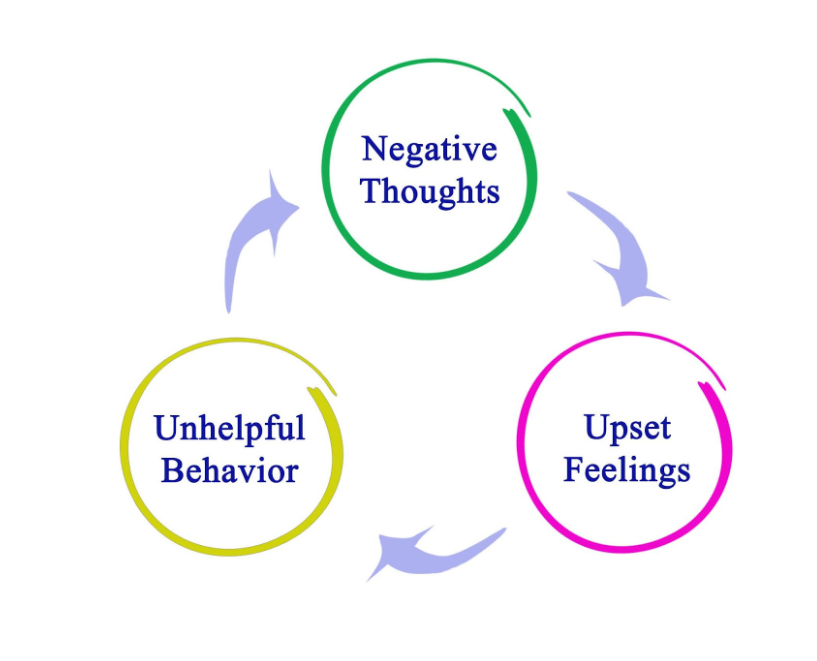
Component | Your Internal Experience | The Cycle Continues |
|---|---|---|
Thought | “That person is a reckless idiot. I am never safe on the road.” (Automatic, negative thought) | Your brain accepts the thought as fact. |
Feeling | Anger, anxiety, and heart racing. | Your body reacts to the perceived threat. |
Behavior | You honk, slam the brakes unnecessarily, and spend the next 20 minutes stewing in traffic, maybe driving too aggressively. | Your behavior reinforces the negative feeling and validates the faulty thought (“Driving is dangerous”). |
The brilliance of CBT is that you don’t have to wait for your intense feelings to magically subside. If you change either the Thought (by challenging it) or the Behavior (by acting differently), the whole triangle shifts, and the feeling will naturally follow suit.
Connect Free. Improve your mental and physical health with a professional near you

The CBT Toolkit: Simple Steps to Intervene
CBT is a hands-on, highly collaborative process. You and your therapist act as detectives, using specific tools to uncover and challenge the thoughts and behaviors that are maintaining your distress.
Tool 1: Identifying Automatic Negative Thoughts (ANTs)
The very first step is awareness. You can’t fix a problem you don’t know exists. Your therapist will help you become vigilant in identifying Automatic Negative Thoughts (ANTs)—those spontaneous, immediate interpretations you make of events, which often fly under the radar.
To catch an ANT, the process is simple: Whenever you experience a strong, negative emotional shift (a sudden rush of anxiety, a drop in mood, or a wave of anger), pause and ask yourself: “What was I just thinking right before I felt this way?” Recording these ANTs in a “Thought Record” is the primary homework of CBT.
Tool 2: Recognizing Cognitive Distortions (The Thought Traps)
Once you’ve caught the ANT, the next step is to challenge its validity by identifying the Cognitive Distortion—the predictable, yet illogical, traps your brain falls into. These are ways your mind filters or misinterprets reality, often twisting information to align with your negative mood.
Distortion (The Trap) | Simple Explanation | Relatable Example |
|---|---|---|
All-or-Nothing Thinking | Seeing things in extremes (perfect or failure). | “If I didn’t ace the presentation, I ruined my career.” |
Catastrophizing | Assuming the absolute worst, most dramatic outcome will happen. | “My boss scheduled a meeting, which means I’m definitely going to be laid off.” |
Mind Reading | Assuming you know what others are thinking negatively about you, without proof. | “They didn’t smile when I walked in; they must think I’m annoying.” |
Emotional Reasoning | Believing something is true just because you feel it strongly. | “I feel overwhelmingly guilty, therefore I must have done something wrong.” |
Should Statements | Holding rigid, unrealistic rules (“should,” “must”) for yourself and others, leading to guilt or resentment. | “I should always know the right answer and never make a mistake.” |
Discounting the Positive | Minimizing or dismissing positive events or traits. | Receiving praise and thinking, “They are just saying that to be nice.” |
Tool 3: Cognitive Restructuring (The Rebuttal)
This is the core skill of CBT thought work. It’s the process of actively challenging the distorted thought using logic and evidence. You are essentially acting as a defense lawyer for yourself, rigorously cross-examining the negative thought to see if it holds up in court.
The Four-Question Test (A Simple Rebuttal Tool):
- What is the objective, factual evidence for this thought? (Stick only to provable facts.)
- What is the evidence against this thought? (List all facts, memories, or circumstances that contradict it.)
- What is the worst that could realistically happen? (Shift from the catastrophic scenario to the actual, moderate outcome.)
- What is a more balanced, realistic thought? (Craft a replacement thought that reflects all the available evidence.)
Example Rebuttal: By challenging the belief that getting fired is inevitable and developing a balanced statement, the feeling shifts from Panic to Concern, allowing for constructive behavior.
Behavior Interventions: Changing What You Do
CBT emphasizes that sometimes the fastest way to change a feeling is to change a behavior. These techniques target the avoidance that fuels anxiety and the inactivity that fuels depression.
Tool 4: Behavioral Activation (The Anti-Depressant Behavior)
When you are depressed, lack of motivation often leads to isolation and inactivity. This causes feelings of low accomplishment and guilt, deepening the depressive spiral.
Behavioral Activation breaks this spiral by focusing on Action First, Feeling Follows.
- You don’t wait until you feel motivated to do a task; you schedule the task and do it anyway. The feeling of minor accomplishment, reduced stress, or renewed connection follows the action, creating a positive, upward spiral.
- You and your therapist schedule small, achievable, value-driven activities (e.g., calling a friend, going for a 15-minute walk, working on a hobby for 10 minutes) and track how these activities impact your mood.
Tool 5: Exposure and Graded Activity (The Anti-Anxiety Behavior)
For anxiety and phobias, the problem is avoidance. The more you avoid a feared situation (e.g., large crowds, flying), the more your brain believes: “I was safe only because I ran away. That situation must be dangerous.”
Exposure Therapy reverses this learning.
- The Fear Ladder: You and your therapist create a hierarchy of feared situations (rating them from 1 to 100).
- Gradual Practice: You start with a small, manageable step (e.g., looking at pictures of the feared thing). You then intentionally face the fear and stay put until your anxiety naturally peaks and then subsides (a process called habituation).
- You only move up the ladder once you have successfully mastered the previous step.
By teaching your brain through experience that you can endure the anxiety without the catastrophic outcome, the fear response naturally deactivates.
The Therapist-Client Partnership in CBT
CBT is a very active, collaborative process, structured more like a coaching relationship than a traditional deep talk therapy.
Homework Is Essential
CBT is most effective when you practice the skills between sessions. Your sessions are for learning the tools and troubleshooting; the real change happens through the consistent application of those tools in your daily life. Showing up to session with your thought record or completed behavioral assignment is a sign of commitment and partnership.
Time-Limited and Focused
CBT is generally more time-limited and goal-oriented than some other therapies. You and your therapist will set specific, measurable goals (e.g., “Reduce severe anxiety episodes from 5 per week to 1 per week”). The focus remains firmly on your present symptoms and the skills needed to overcome them efficiently.
Empowerment and Self-Sufficiency
The ultimate goal of CBT is to make you your own therapist. The techniques are highly structured so that once you internalize them, you can perform cognitive restructuring and behavioral experiments on your own, long after therapy has concluded.
The Final Word: You Are the Boss of Your Brain
Understanding the CBT model is realizing that while you can’t always control the events in your life, you can absolutely control how you choose to interpret and respond to them.
Those negative, automatic thoughts that feel like hard truth are simply habits of mind—patterns that your brain has learned. And like any habit, they can be unlearned and replaced with healthier, more realistic ones.
CBT gives you the map and the tools to take back control. With practice, you will learn to spot the traps, challenge the distortions, and choose behaviors that pull you up, not drag you down. You are ready to start retraining your brain.

Free consultations. Connect free with local health professionals near you.
The CBT Advantage: Sustaining Your New Mental Habits
A New Chapter of Empowerment
If you have followed this guide, you have not just learned about a type of therapy; you have been given the foundational knowledge to become the active architect of your own mental health. You understand that the chaos you once felt was often the result of an invisible yet predictable cycle: automatic negative thoughts (ANTs) triggering intense emotions and leading to counterproductive behaviors.
We started this journey by acknowledging that your thoughts felt like unbreakable facts. The most profound conclusion of engaging with Cognitive Behavioral Therapy is the realization that thoughts are not facts. They are hypotheses. They are opinions. They are old mental habits that can be tested, challenged, and ultimately replaced.
Choosing CBT is choosing empowerment. It’s a commitment to a life where you no longer feel like a victim of your own mind, but rather the conscious, deliberate boss of your cognitive process. This conclusion is about solidifying those gains, understanding the long-term impact of your new skills, and recognizing that the hardest work—the consistent practice—is what guarantees lasting change.
The Three Pillars of Lasting Change
The transformation achieved through CBT is built on three enduring pillars that will continue to support you long after your weekly sessions conclude.
Cognitive Flexibility: The Anti-Anxiety Armor
Before CBT, your mind was likely rigid, prone to all-or-nothing thinking or catastrophizing. When a minor setback occurred, your mind immediately jumped to the worst possible conclusion.
CBT teaches you cognitive flexibility. This is the ability to generate and genuinely consider multiple, balanced interpretations of any given event. For example, instead of interpreting a friend missing a call as “They hate me” (Mind Reading), you can quickly generate three alternatives: “They are in a meeting,” “They are driving,” or “They simply forgot.”
This flexibility is the ultimate armor against anxiety. It dismantles the power of the ANTs because you have trained your brain to default to the most realistic scenario, not the most terrifying one. You learn to live in the gray areas, which is where real life actually happens.
Emotional Regulation Through Behavior: The Anti-Depression Shield
For those struggling with depression or intense anxiety, feelings often felt like an insurmountable wall. CBT showed you that you don’t have to wait for your motivation to be high (for depression) or your fear to be low (for anxiety) to take action.
- Behavioral Activation proves that action creates motivation, reversing the depressive spiral. By consistently scheduling small, value-driven activities, you learn that you can literally act your way out of a slump, generating feelings of accomplishment and pleasure that were previously unattainable.
- Exposure Therapy proves that you can endure intense fear without harm. Every time you face a feared situation on your fear ladder and stay until the anxiety subsides, you give your nervous system tangible, real-world evidence of safety. This is a foundational, biological recalibration of your emotional response.
Relapse Prevention: Embracing the “Slip”
A core principle of CBT is preparing for setbacks. No one changes a lifetime of habits overnight, and no one masters a mental skill without practice.
Relapse prevention in CBT teaches you that a “slip” (a temporary return to old thinking or behavior) is not a failure; it’s a learning opportunity.
- The Cognitive Trap: You might have an old ANT pop up that says, “I had a panic attack today, so therapy didn’t work, and I’m back to square one.” (All-or-Nothing Thinking).
- The CBT Response: You recognize the distortion, apply the Four-Question Test, and create a new, balanced thought: “I had a panic attack, but last year I had five. I used my deep breathing, and it ended in 10 minutes instead of an hour. This is a setback, not a failure. I know how to get back on track.”
This proactive approach stops a temporary slip from turning into a full-blown relapse.
Sustaining the Practice: Becoming Your Own Therapist
The beauty and long-term success of CBT hinge entirely on your ability to adopt the tools as your own life philosophy. Your therapist was the coach who taught you the plays; now, you are the quarterback running the game.
Making Thought Records a Habit
While you won’t need to fill out formal worksheets forever, the skill of catching ANTs and challenging them must become automatic. When a negative feeling hits, your immediate reaction should be to stop and ask: “What is the evidence?”
- The Daily Practice: Treat your thought records (or your mental rebuttal process) like a muscle. It gets stronger with consistent use. Practice challenging small, daily irritations (traffic, a clumsy moment, a forgotten item) so that when a major crisis hits, your cognitive “muscle memory” kicks in automatically.
The “Behavioral Experiment” Mindset
CBT encourages a mindset of continuous curiosity, where life events are not judgments against your worth, but behavioral experiments.
- The Mindset Shift: Instead of seeing a social event as a pass/fail test (“I have to impress everyone”), you see it as an experiment: “I will try speaking up three times, and then I will observe what actually happens.”
- No Failure, Only Data: If the outcome isn’t what you hoped, it’s not a failure. It’s simply data that informs your next experiment. This stance removes the anxiety of perfectionism and replaces it with the thrill of learning.
The Importance of Booster Sessions
Even after formal CBT concludes, many people find great value in returning for “booster sessions.”
- These are typically one or two sessions scheduled 6 or 12 months after termination to review your tools, address any new, complex ANTs that have popped up, and troubleshoot difficult life transitions. It’s a professional tune-up for your mental health toolkit.
The Final Word: You Are the Boss of Your Brain
The ultimate gift of CBT is self-efficacy—the belief that you have the power to change your own outcomes. You have learned that the internal voice that once paralyzed you with anxiety or sadness is not a master, but a habit-driven machine that you can reprogram.
You are no longer passively absorbing the distortions of your mind; you are actively confronting them with evidence and logic. You are replacing the downward spirals of depression and anxiety with the upward trajectory of action and balanced thinking.
The work is challenging, but the freedom you gain is profound. Continue to practice your skills, challenge your thoughts, and choose behaviors aligned with the life you want to live. You are the boss of your brain, and your healing journey, powered by these simple, effective tools, is just getting started.
Time to feel better. Find a mental, physical health expert that works for you.
Common FAQs
You’ve learned that CBT is a practical, hands-on approach to retraining your mind. Here are answers to common questions people have about getting started with this powerful therapy.
How is CBT different from traditional "talk therapy" or counseling?
The main difference is the focus and the structure.
Feature | Cognitive Behavioral Therapy (CBT) | Traditional Talk Therapy (Psychodynamic) |
|---|---|---|
Focus | The present. Focus is on current thoughts, feelings, and behaviors. | The past. Focus is often on childhood experiences and historical roots of problems. |
Goal | Learning specific skills and tools (like cognitive restructuring) to manage symptoms. | Gaining deep insight into underlying motivations and unconscious patterns. |
Nature | Time-limited and highly collaborative (like a coach and student). | Often open-ended and based largely on the relationship with the therapist. |
CBT is primarily focused on what to do about a problem now, not just why you have it.
Is CBT effective for everyone, or just for certain issues?
CBT is one of the most widely researched forms of psychotherapy and has proven effectiveness for a broad range of conditions. It is considered the gold standard treatment for:
- Anxiety Disorders: Generalized Anxiety Disorder (GAD), Social Anxiety, Panic Disorder, and Phobias.
- Depression.
- Obsessive-Compulsive Disorder (OCD).
- Insomnia (CBT-I).
- It is also highly useful for managing chronic pain, anger issues, and eating disorders.
While it is broadly effective, some people find that combining it with other therapies (like deeper psychodynamic work) is best for complex or long-standing issues.
How long does CBT usually take?
CBT is designed to be time-limited and efficient.
- A typical course of CBT often lasts between 12 and 20 sessions (3 to 6 months), depending on the severity of the symptoms and the specific goals.
- Some highly focused treatments, like those for specific phobias using Exposure Therapy, can sometimes be shorter. Because the goal is self-sufficiency, sessions decrease in frequency as you master the tools.
Common FAQs
The CBT Toolkit and Homework
What are "Cognitive Distortions," and why are they important?
Cognitive Distortions are faulty, habitual ways of thinking that twist reality and maintain negative feelings. They are mental traps your brain falls into.
- Example: Catastrophizing is assuming the absolute worst possible outcome (e.g., “I forgot one step, so I will definitely be fired and lose everything”).
- By identifying the distortion, you remove its power. Your therapist helps you label the error in logic and replace it with a more balanced, evidence-based thought.
I hate homework. Do I really have to do assignments between sessions?
Yes, homework is essential for CBT success. The change happens through consistent practice, not just during the session.
- Think of it like physical therapy: You learn the exercises in the clinic, but the strength is built by practicing at home.
- CBT Homework is simply the practice of the tools you learn: filling out a Thought Record (to catch your ANTs), practicing a step on your Fear Ladder (for anxiety), or scheduling a specific enjoyable activity (for depression). This practice is what turns a new concept into an automatic, healthy habit.
What is "Exposure Therapy," and is it necessary for anxiety?
xposure Therapy is a core behavioral tool used to treat anxiety, panic, and phobias. It is often necessary because avoidance is what keeps anxiety alive.
- The Process: You confront a feared situation (the “exposure”) gradually and intentionally, starting with a very easy step (a “Fear Ladder”).
- The Goal: To stay in the situation long enough for your anxiety to peak and then drop naturally. This teaches your brain, through experience, that you can survive the feeling of anxiety without the feared catastrophe occurring.
Common FAQs
Long-Term Success
Will I have to do thought records forever?
No. The goal is not to fill out worksheets forever, but to make the skill of self-reflection and challenging your thoughts automatic.
- Over time, the process moves from a written exercise to a quick, mental check-in. When a negative thought strikes, you’re brain’s new “muscle memory” will prompt you to automatically ask, “What is the evidence for that?”
- The therapy aims to make you your own therapist for life.
Does CBT ignore my past and my childhood?
CBT does not ignore your past, but it doesn’t dwell there.
- CBT acknowledges that your past experiences (including childhood) heavily influenced the development of your current thought patterns and core beliefs. It uses this context to understand why you have certain automatic negative thoughts.
- However, the focus remains firmly on solving present problems by changing current thought and behavior habits, rather than solely exploring the history of their formation.
People also ask
Q: What is the 5 minute rule in CBT?
A: The 5-minute rule is one of a number of cognitive behavioral therapy techniques for procrastination. Using the 5-minute rule, you set a goal of doing whatever it is you would otherwise avoid, but you only do it for a set amount of time: five minutes.
Q:Can I do CBT on my own?
A: Some mental health clinicians use CBT techniques with their patients, but you can also use them on your own for everyday challenges. You don’t need to work with a professional or have a mental health diagnosis. CBT techniques can be easy to adopt — they just take practice.
Q: What are the 7 pillars of CBT?
A: They are: clarity (shared definitions of CBT and its terminology), coherence (shared therapeutic principles and theory), cohesion (integration of individuals and subgroups using CBT), competence (assessing standards during training and personal development), convenience (accessibility and public awareness),
Q:What is the best lifestyle for anxiety?
A: Lifestyle changes, such as sleeping better, getting more social support, using techniques that lower stress and getting regular exercise, also may help. Be patient, as it may take some time before these changes affect your anxiety.
NOTICE TO USERS
MindBodyToday is not intended to be a substitute for professional advice, diagnosis, medical treatment, or therapy. Always seek the advice of your physician or qualified mental health provider with any questions you may have regarding any mental health symptom or medical condition. Never disregard professional psychological or medical advice nor delay in seeking professional advice or treatment because of something you have read on MindBodyToday.
Share this article

Let us know about your needs

Quickly reach the right healthcare Pro

Message health care pros and get the help you need.
Popular Healthcare Professionals Near You
You might also like

What is Psychodynamic Therapy Principles?
, What is Psychodynamic Therapy Principles? Everything you need to know Find a Pro Digging Deeper: A Simple Guide to […]

What is Dialectical Behavior Therapy (DBT)?
, What is Dialectical Behavior Therapy (DBT) ? Everything you need to know Find a Pro Navigating the Storm: Understanding […]

What is Cognitive Behavioral Therapy (CBT)?
, What is Cognitive Behavioral Therapy (CBT) ? Everything you need to know Find a Pro Your Thoughts Are Not […]

