Your Thought Toolkit: A Simple Guide to Cognitive Behavioral Therapy (CBT)
If you are thinking about starting therapy, or if you’re already on your journey, you’ve probably heard of Cognitive Behavioral Therapy (CBT). It’s one of the most common and widely studied types of talk therapy out there, and for good reason: it works for a lot of people dealing with a lot of different problems, from anxiety and depression to sleep issues and chronic pain.
But what is it, really? Does it mean you have to be super intellectual or disciplined?
Absolutely not.
Think of CBT not as a complicated academic theory, but as a practical, hands-on toolkit. It’s a way to become a detective of your own mind, helping you spot the negative thought patterns and habits that keep you stuck, and teaching you simple, repeatable skills to change them. It’s about learning to be your own best coach.
This article is your warm, supportive guide to understanding the basics of CBT—what it is, how it works, and why it focuses on the “here and now” to help you build a healthier future.
Time to feel better. Find a mental, physical health expert that works for you.
The Core Idea: Thoughts, Feelings, Actions
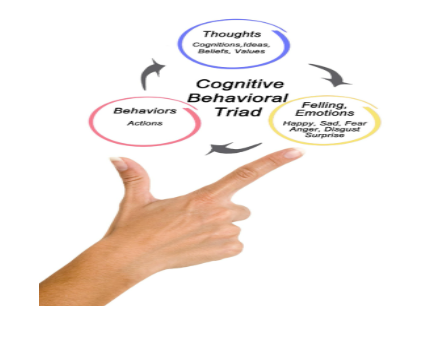
At the heart of CBT is one simple, powerful concept: our thoughts, feelings, and actions are all interconnected and constantly influence each other.
Imagine you are standing at the top of a hill. You see a chain reaction that keeps you running in the same unproductive loop. The core model is often illustrated as a triangle:
The CBT Triangle: Thoughts →Feelings → Actions
- Thoughts (Cognitions): These are the automatic things you say to yourself. They can be judgments, predictions, or interpretations. Example: “I failed that test, so I must be stupid.”
- Feelings (Emotions): These are the emotional responses to your thoughts. They are the physiological and subjective experience. Example: The thought leads to feeling deep Sadness and Anxiety.
- Actions (Behaviors): These are the things you do (or don’t do) in response to your feelings. Example: The sadness and anxiety lead you to avoid studying for the next test, or cancel plans with friends.
The loop then begins again: Avoidance (Action) reinforces the thought “I can’t handle this” (Thought), which intensifies the Anxiety (Feeling). CBT’s brilliance is that it recognizes that trying to control a strong feeling (like panic) is incredibly hard. But, it is often much easier to change a thought or an action—and by changing one corner of the triangle, you break the whole cycle.
Step 1: Becoming a Thought Detective
The very first part of CBT involves learning to identify your Automatic Negative Thoughts (ANTs). These are the quick, often inaccurate thoughts that pop up and color your reality without you even realizing it. They are often based on habits, not facts.
Identifying Cognitive Distortions
Your therapist will teach you about common “thinking traps” or cognitive distortions that fuel anxiety and depression. These are patterns of irrational thinking that can warp your perception of reality. Recognizing them is like naming the enemy.
|
Thinking Trap (Distortion)
|
What It Is
|
How It Sounds
|
|
All-or-Nothing Thinking
|
Seeing things only in extremes (perfect or failure). No middle ground.
|
“If I don’t get the promotion, my whole career is a total disaster.”
|
|
Catastrophizing
|
Blowing things out of proportion, always expecting the worst possible outcome.
|
“My partner hasn’t texted back in two hours. They must have been in a terrible accident.”
|
|
Mind Reading
|
Assuming you know what others are thinking, usually negatively, without any evidence.
|
“My friend didn’t smile when they saw me; they must be annoyed with me.”
|
|
Should Statements
|
Holding yourself (or others) to rigid, impossible rules defined by “should” or “must.”
|
“I should always be happy and never feel stressed.”
|
|
Overgeneralization
|
Drawing a sweeping negative conclusion based on only one single event.
|
“I made a mistake in that email, so I’m clearly incompetent at everything I do.”
|
|
Mental Filter
|
Picking out a single negative detail and dwelling on it exclusively, ignoring all positive aspects.
|
“I got five compliments on my presentation, but one person criticized my slide. I must be terrible at public speaking.”
|
The Detective’s Tool: Thought Records
Your therapist will likely assign you simple homework using a Thought Record or log. This is your core detective tool. You won’t just talk about vague worries; you’ll document specific events, analyze the associated thought, and challenge its validity.
|
Situation
|
Thought (ANT)
|
Emotion
|
Evidence FOR the Thought
|
Evidence AGAINST the Thought
|
Balanced Thought
|
|
My boss asked me to re-do a report.
|
I must be bad at my job and they’ll fire me (Catastrophizing).
|
Fear, Anxiety (8/10)
|
I had to re-do a report last month, too.
|
My boss complimented my work on the presentation last week. The report needed minor formatting fixes, not major changes.
|
“I made a small mistake that I need to correct. This doesn’t mean I’m bad at my job; it means I’m learning.”
|
This exercise forces you to slow down, challenge your thoughts using logic and factual evidence, and move from automatic judgment to rational analysis. It’s like trading a foggy pair of glasses for a clear lens. The goal is not to force positive thoughts, but to find a thought that is balanced and realistic.
Step 2: Changing Your Actions (Behavioral Component)
The “Behavioral” part of CBT focuses on the Actions corner of the triangle. Many times, our negative thoughts lead us to behaviors that reinforce the very problems we’re trying to solve, creating a self-fulfilling prophecy.
For example, if you are depressed, the thought “I’m too tired and nothing is fun” leads to the action of staying in bed and isolating. While staying in bed might feel comfortable in the moment, it actually reinforces the depression by depriving you of positive experiences and social connection.
Connect Free. Improve your mental and physical health with a professional near you
Behavioral Activation (BA)
A key CBT technique for depression is Behavioral Activation (BA). It involves systematically scheduling and engaging in activities, even if you don’t feel like it, to break the cycle of withdrawal.
- Action Before Motivation: BA recognizes that motivation often follows action, it rarely precedes it. You don’t wait until you feel motivated to go for a walk; you go for the walk, and then the activity generates a small feeling of motivation or accomplishment.
- The Focus: The focus is on two types of activities:
- Mastery: Activities that give you a sense of accomplishment and competence (e.g., cleaning the kitchen, finishing a difficult puzzle, learning a new skill).
- Pleasure: Activities that give you enjoyment, relaxation, or connection (e.g., calling a friend, listening to music, gardening).
By gently pushing yourself to do these things, you generate evidence against your negative thoughts (e.g., “I went outside, and I actually felt a little better—the thought that nothing is fun isn’t entirely true”).
Exposure and Response Prevention (ERP)
This is a powerful behavioral technique used specifically for anxiety disorders, phobias, and Obsessive-Compulsive Disorder (OCD).
- The Idea: Anxiety makes you want to avoid the thing that scares you. Avoidance gives you temporary relief, but it teaches your brain that the feared situation is dangerous. ERP involves facing your fears (Exposure) without resorting to your usual coping or avoidance mechanisms (Response Prevention).
- The Method (The Fear Ladder): You and your therapist create a hierarchy of fears, from least scary to scariest (e.g., holding a picture of a spider, then looking at a spider in a jar, then gently touching the jar). You then slowly, systematically face those fears, starting at the bottom rung, staying with the anxiety until it naturally subsides (this process is called habituation). Your brain eventually learns: “I faced the scary thing, the terrible thing didn’t happen, and the anxiety went down.” This practice essentially re-writes the fear circuit in your brain.
What to Expect: Practicalities of CBT
CBT is a distinct type of therapy, and knowing what to expect can help you feel prepared and committed to the process.
- It’s Collaborative and Practical
- Teamwork: You and your therapist work as a team, setting clear, measurable goals. It’s not about endlessly analyzing your childhood (though your past may inform your present thinking); it’s about solving current, pressing problems and changing future behavior.
- Skill-Based: CBT is highly focused on teaching skills (like thought challenging, relaxation techniques, and communication strategies) that you will use for the rest of your life. The focus is on empowering you to become your own therapist.
- It’s Time-Limited and Structured
- Duration: Unlike some open-ended forms of therapy, CBT is often time-limited, typically lasting anywhere from 8 to 20 sessions, depending on the severity of the issue and the consistency of the homework. The goal is efficiency and self-sufficiency.
- Session Structure: Sessions are structured. You’ll likely review your “homework” from the previous week, set a specific agenda for the current session, work on a specific thought or skill, and then agree on new homework for the week ahead. This structured format helps keep the focus on measurable progress.
- Homework is Essential
The real work of CBT happens between sessions. Your therapist isn’t a magician who waves a wand; they are a coach who assigns drills.
- Practice Makes Permanent: Doing the thought records, practicing a new behavioral action, or completing an exposure exercise is how you retrain your brain. Every time you challenge a thought, you weaken the negative connection and strengthen the healthy, balanced one. If you skip the homework, you skip the change. Consistency is key to establishing new neural pathways.
Is CBT Right for Me?
CBT has been proven effective and is often the first-line treatment recommended for a wide range of common mental health challenges:
- Anxiety Disorders: Generalized Anxiety Disorder (GAD), Panic Disorder, Phobias, Social Anxiety.
- Depression: Mild to moderate depression.
- Obsessive-Compulsive Disorder (OCD): Using ERP.
- Post-Traumatic Stress Disorder (PTSD): Often using trauma-focused adaptations of CBT.
- Sleep Issues (Insomnia): Using CBT for Insomnia (CBT-I).
- Chronic Pain: Managing the thoughts and behaviors related to pain flare-ups and improving quality of life.
CBT is an empowering and realistic way to approach emotional problems. It tells you that while your feelings are valid, your thoughts are not always facts, and you have the power to change both your perspective and your behavior. It’s a commitment to learning new skills, and the best part is that once you have the toolkit, you carry it with you forever.
Free consultations. Connect free with local health professionals near you.
Conclusion
Becoming Your Own Cognitive Coach
You’ve now thoroughly explored the world of Cognitive Behavioral Therapy (CBT), understanding its core principle: the dynamic interplay between your thoughts, feelings, and actions. You’ve learned how to be a detective, spotting the “thinking traps” or cognitive distortions that keep you stuck, and you’ve seen the power of behavioral strategies like Exposure and Behavioral Activation.
This concluding article focuses on the long-term goal of CBT: therapeutic independence. It’s about moving from being a student of CBT to becoming your own lifelong coach and therapist. The end of formal CBT sessions isn’t an ending at all—it’s the graduation into a new way of managing your mind.
Graduating from the CBT Classroom
CBT is often time-limited and structured because its ultimate goal is to equip you with a self-sufficient toolkit. Unlike some forms of therapy that encourage a long, continuous therapeutic relationship, CBT aims to make you the expert of your own thought patterns.
The Shift from Dependence to Self-Correction
During the initial phases of CBT, you rely heavily on your therapist to guide you through the Thought Records and push you through difficult behavioral experiments. You need their expertise, encouragement, and accountability.
However, as therapy progresses, this reliance changes. You begin to internalize the therapist’s voice. When an Automatic Negative Thought (ANT) pops up (“I’m going to fail this presentation”), you immediately hear that internalized voice asking:
- “What type of cognitive distortion is that?” (Ah, Catastrophizing.)
- “What is the evidence against this thought?” (I’ve done ten successful presentations before.)
- “What is the balanced, realistic thought?” (I feel nervous, but I am prepared, and I can handle it even if I stumble.)
This ability to rapidly identify, challenge, and replace inaccurate thoughts—without needing external validation—is the true mark of graduation.
Maintaining Your CBT Toolkit
Your CBT toolkit is like a set of muscles: if you don’t use them, they weaken. The key to long-term success is maintenance.
- Spot Check Your Thoughts: Commit to using a Thought Record (or a simplified version) immediately after a stressful event or whenever you feel your mood plummeting. You don’t need to log every thought, but log the thoughts associated with high-stakes moments.
- Continue Behavioral Activation: Even when you feel great, schedule a few “mastery” or “pleasure” activities into your week. This keeps your momentum going and builds a buffer against future dips in mood.
- Practice Exposure (The “Relapse Prevention” Test): If you had an anxiety disorder or phobia, intentionally seek out low-level exposures periodically. For example, if you overcame social anxiety, commit to initiating one friendly conversation with a stranger each month. This reaffirms your brain’s learning that the feared situation is safe.
Addressing the Reality of Relapse
It’s important to be realistic: life is full of stress, setbacks, and sometimes, crisis. No therapy guarantees you will never feel depressed, anxious, or stressed again. This is where CBT’s practical, skill-based nature shines in relapse prevention.
Relapse is a Signal, Not a Failure
In CBT, falling back into old thought or behavior patterns is not considered a personal failure; it’s considered a signal that you need to engage your skills.
- The Problem: Many people mistake a relapse for proof that “therapy didn’t work.” This is the “All-or-Nothing Thinking” distortion in action!
- The CBT Response: A small setback is just data. It means you were using your old, unhelpful tool. The CBT approach is simple: acknowledge the relapse, pull out the Thought Record, and start logging again. You know what to do; you just need to do it consistently.
The “ABC” Framework for Crisis
Your therapist likely taught you simplified frameworks to use during high-stress moments. The “ABC” model is a classic CBT tool for rapid self-assessment:
- A – Activating Event: What actually happened? (e.g., I got a rejection email.)
- B – Beliefs (The Thought): What did I immediately think? (e.g., I’m a fraud and I’ll never succeed.)
- C – Consequences (Feelings/Actions): How did I feel and what did I do? (e.g., Felt paralyzed sadness; spent two hours scrolling social media.)
During a crisis, simply identifying A, B, and C can be enough to interrupt the negative cycle and give you the clarity needed to apply a more Balanced Thought and helpful Action.
Integrating CBT with Your Whole Self
While CBT is famous for its practical, logical approach, its insights have a profound emotional and existential impact. The end of therapy isn’t just about changing thoughts; it’s about changing your Core Beliefs.
Uncovering the Core Beliefs
Cognitive distortions are surface-level thoughts (ANTs), but they all stem from deeper, foundational Core Beliefs you formed earlier in life—often beliefs like:
- “I am unlovable.”
- “I am incompetent.”
- “The world is unsafe.”
Your CBT therapist helped you gather so much evidence against your ANTs that, eventually, you were able to weaken that rigid, long-held Core Belief. For example, if you repeatedly used the Thought Record to challenge the idea that “I’m a failure,” over time, the Core Belief “I am incompetent” starts to shift to a more realistic and compassionate belief: “I am capable, and sometimes I make mistakes.”
This is the real, lasting transformation of CBT. It moves beyond solving problems to fundamentally changing your relationship with yourself.
The Path to Self-Compassion
CBT often starts with a focus on logic and evidence, which can feel challenging and demanding. However, the ultimate outcome of successfully challenging negative self-talk is Self-Compassion.
By proving to yourself, through countless examples, that your harsh, critical thoughts are inaccurate, you naturally replace that inner critic with a kinder, more realistic inner coach. You learn to accept your flaws and your humanity, knowing that making a mistake does not define your worth.
By embracing the skills and insights of CBT, you ensure that the deep, structural work you’ve done in therapy continues to serve you every day. You have the toolkit; now you are ready to be the master builder of your own well-being.
Time to feel better. Find a mental, physical health expert that works for you.
Common FAQs
Here are some common questions people have when they are starting or considering Cognitive Behavioral Therapy (CBT).
People also ask
Q: What is the simple explanation of cognitive behavioral therapy?
A: It helps people to develop skills and strategies for becoming and staying healthy. CBT focuses on the here-and-now—on the problems that come up in day-to-day life. CBT helps people to examine how they make sense of what is happening around them and how these perceptions affect the way they feel.
Q:Can CBT help with insomnia?
A: Sometimes you’ll be offered cognitive behavioural therapy (CBT). This may be face-to-face with a therapist, or through an online self-help programme. This can help you change the thoughts and behaviours that keep you from sleeping.
Q: Can CBT help with derealization?
A: Depersonalization-derealization disorder (DDD) is characterized by feelings of “unreality” about the self and/or external world. Cognitive Behavioral Therapy adapted for DDD (CBT-f-DDD) has been effective in published clinical audits.
Q:What are the 7 pillars of CBT?
A: They are: clarity (shared definitions of CBT and its terminology), coherence (shared therapeutic principles and theory), cohesion (integration of individuals and subgroups using CBT), competence (assessing standards during training and personal development), convenience (accessibility and public awareness),