
Group Therapy Dynamics: A Microcosm for Interpersonal Learning and Therapeutic Change
Group Therapy is a highly effective, specialized form of psychotherapy that capitalizes on the power of the group as a social environment and a primary agent of change. Unlike individual therapy, which focuses on the client’s relationship with the therapist, group therapy uses the complex, multi-faceted relationships formed among members to foster personal growth, improve interpersonal skills, and achieve therapeutic goals. The central theoretical tenet, largely developed by Irvin Yalom, is that the group setting naturally recreates the participants’ dysfunctional familial and social interaction patterns, making the group itself a “social microcosm.” The dynamic interactions, conflicts, supports, and resolutions that occur within the group provide immediate, emotionally salient feedback, allowing members to observe, understand, and ultimately change the very behaviors that impede their functioning in the outside world. Group therapy is particularly valuable for addressing issues related to isolation, relational trauma, and difficulties with intimacy and boundary-setting. Its efficacy rests on the systematic harnessing of therapeutic factors—mechanisms unique to the group setting that drive deep-seated psychological change. Modern group practice integrates diverse theoretical orientations, including psychodynamic, interpersonal, cognitive-behavioral, and humanistic models, all unified by a focus on the shared experience of relational healing.
This comprehensive article will explore the historical roots of group psychotherapy, detail the foundational concept of the group as a social microcosm, and systematically analyze the primary therapeutic factors that mediate change within the group setting. Understanding these dynamics is paramount for appreciating the complexity and potency of the group environment as a powerful laboratory for human connection and behavioral transformation.
Time to feel better. Find a mental, physical health expert that works for you.
- Historical Context and Foundational Concepts
The history of group therapy reflects its evolution from practical, supportive measures to a sophisticated psychological intervention focused on interpersonal process. Its development solidified the group’s role as a potent catalyst for relational learning.
- Origins and Development
Group treatment modalities initially emerged from practical necessity before evolving into a distinct theoretical discipline.
- Early 20th Century: Early precursors included the work of Joseph Pratt, who used group meetings for the moral and educational support of tuberculosis patients, focusing on didactic instruction and morale boosting. The initial focus was pragmatic, supportive, and largely educational rather than psychodynamic or interpersonal.
- The Interpersonal Shift: Key figures like Trigant Burrow and, later, Kurt Lewin (Group Dynamics) began to recognize the inherent therapeutic power in the interactions among members. However, it was S.H. Foulkes in the UK (with his concept of the Group-Analytic Matrix, emphasizing the shared, unconscious network of the group) and Irvin D. Yalom in the US who formalized the theory of the group process as the primary mechanism of change. Yalom’s systematic identification of the Curative Factors became the foundation for modern practice, moving the focus definitively from individual pathology to relational dynamics.
- The Social Microcosm
The concept of the social microcosm is the central organizing principle of dynamic, process-oriented group psychotherapy.
- Recreating Reality: The group setting, over time, functions as a miniature society or a “social microcosm” in which members unconsciously and spontaneously exhibit their characteristic maladaptive interpersonal behaviors and relational difficulties. A person who is overly competitive, perpetually passive, overly placating, or aggressively dominant in the outside world will demonstrate those exact same patterns within the group. The group becomes the stage where their life script is performed.
- Here-and-Now Focus: The therapist encourages a focus on the “here-and-now”—the immediate interactions and feelings occurring among members and toward the leader in the group room—rather than dwelling exclusively on past or external events. By focusing on the process (how people are interacting, the underlying emotion) rather than just the content (what they are talking about), the group gains direct, immediate access to the pathological interaction patterns as they unfold in real-time.
- Transference Replication: The group setting creates a rich environment for multiple transference relationships. Members project feelings and expectations onto the leader (vertical transference) and onto other members (lateral transference), replicating dynamics from their families of origin or past significant relationships. Working through these replicated transferences in the safety of the group allows for corrective emotional experiences.
- The Curative Factors of Group Psychotherapy
Irvin Yalom systematically identified eleven Curative Factors—the specific, powerful mechanisms through which change occurs uniquely in the group setting—which fundamentally distinguish group therapy from individual work.
- Factors Addressing Isolation and Shared Experience
These factors are vital early on, reducing the client’s sense of uniqueness, shame, and alienation, thereby promoting initial engagement.
- Instillation of Hope: Seeing other members at various stages of recovery, particularly those who have successfully navigated similar issues, provides clients with the essential belief that their own change and mastery of problems is possible.
- Universality: The powerful realization that one’s thoughts, feelings, and problems are not unique, but are shared by others, profoundly reduces feelings of shame, isolation, and alienation. This recognition creates a powerful bond and validates the client’s experience.
- Imparting Information: This includes both didactic instruction from the leader (e.g., psychoeducation about mental illness, coping mechanisms) and direct advice or suggestion from fellow group members regarding practical life or coping strategies.
- Factors Focusing on Relational and Emotional Learning
These factors drive the deeper, enduring interpersonal and affective change that is the core goal of dynamic group work.
- Altruism: Members gain self-esteem, a sense of value, and a shift in perspective by offering genuine support, insight, and assistance to others. This process shifts their focus from perpetual self-concern to external contribution.
- The Corrective Recapitulation of the Primary Family Group: The group leader and the members provide a functional, less dysfunctional family prototype. Interpersonal conflicts, often rooted in early family dynamics, are re-experienced and worked through with a resolution that is more adaptive and emotionally resonant than what was achieved in the original family, leading to emotional healing.
- Interpersonal Learning (Input and Output): This factor is two-fold: Input involves receiving honest, often critical, but caring feedback from others about one’s interpersonal style, behavior, and “blind spots.” Output involves members experimenting with new, more flexible interpersonal behaviors (e.g., asserting a boundary, disclosing a vulnerable feeling) within the safety of the group environment.
- Cohesiveness: This is the group equivalent of the therapeutic alliance in individual work. It refers to the attraction members feel toward the group and the other members, and the resulting sense of belonging, value, and safety within the group. High cohesiveness is a prerequisite for effective work, as it allows members to tolerate the emotional pain of conflict and honest feedback.
Connect Free. Improve your mental and physical health with a professional near you
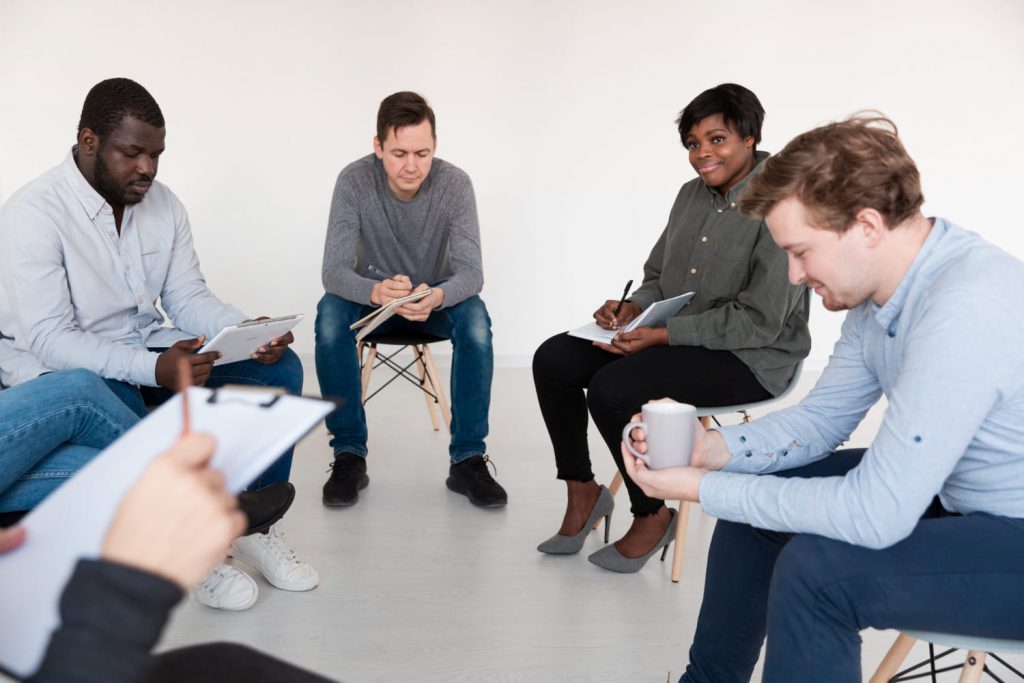
III. Dynamics of Group Process
The effectiveness of group therapy depends heavily on the skillful management of the ongoing, dynamic process unfolding among members, guided by the leader’s consistent focus on the here-and-now.
- Stages of Group Development
Groups typically move through identifiable phases, each presenting specific dynamic challenges that must be successfully navigated for deeper work to occur.
- Initial Stage (Forming): Characterized by initial anxiety, politeness, superficial communication, and dependency on the leader for structure and safety. Members test the waters and seek common ground.
- Transition/Conflict Stage (Storming): Marked by open resistance, hostility toward the leader (testing boundaries and authority), and genuine conflict among members as they assert their individuality and negotiate group norms. Successfully working through this stage is critical for achieving true cohesion and moving to the working phase.
- Working Stage (Norming/Performing): Characterized by high cohesiveness, deep commitment to therapeutic work, increased self-disclosure, and the ability to give and receive effective feedback without major dissolution. The group’s primary focus shifts from external concerns to here-and-now process.
- Termination Stage (Adjourning): Focuses on managing the inevitable feelings associated with separation, loss, and the anxieties related to applying learning to the outside world.
- The Therapist’s Role
The group leader is an active Process Observer and Facilitator, responsible for establishing and maintaining the essential norms that enable the therapeutic factors to operate effectively. This role includes: modeling appropriate self-disclosure, intervening to protect vulnerable members from excessive aggression, continually guiding the focus back to the here-and-now interaction, and interpreting process dynamics to foster deeper insight among members.

Free consultations. Connect free with local health professionals near you.
Conclusion
Group Therapy—The Relational Path to Deep and Enduring Change
The detailed examination of Group Therapy Dynamics confirms its unique and profound efficacy as a specialized form of psychotherapy. The model’s strength lies in its central theoretical premise: the group itself functions as a “social microcosm,” a dynamic laboratory where members spontaneously recreate their core relational issues, allowing these maladaptive patterns to be observed, challenged, and ultimately changed in real-time. The therapeutic change is mediated by the systematic operation of the eleven Curative Factors identified by Yalom, which collaboratively address the core human problems of isolation, relational deficiency, and lack of self-awareness. This conclusion will synthesize the critical role of cohesiveness as the necessary precondition for deep work, detail the essential nature of interpersonal learning as the primary engine of behavioral change, and affirm the overarching goal of group therapy: the translation of insights and behaviors learned in the group setting to the client’s external life.
- Cohesiveness as the Foundation for Change
Of all the Curative Factors, Cohesiveness is arguably the most critical, as it serves as the necessary precondition that allows the other, more challenging factors (like Interpersonal Learning and Corrective Recapitulation) to operate without leading to premature termination or withdrawal.
- Defining Cohesiveness
Cohesiveness is the group equivalent of the therapeutic alliance in individual therapy. It refers to the attraction members feel toward the group, the group leader, and the other members, and the resulting sense of belonging, value, and safety.
- The Sense of Safety: High cohesiveness provides a psychologically safe environment where members feel accepted and understood despite their flaws. This safety is paramount because the work of dynamic group therapy requires members to engage in high-risk behaviors: giving and receiving critical feedback, challenging transference dynamics, and disclosing highly vulnerable material. Without a foundation of safety, the normal human response to this intensity would be defensiveness and retreat.
- Tolerating Conflict: Cohesiveness enables the group to move successfully through the inevitable Transition/Conflict Stage (Storming). When members feel valued and attached to the group, they are able to tolerate the emotional pain of conflict, assert boundaries, and work through disagreements without dissolving the group. The successful resolution of conflict in a cohesive environment becomes a powerful Corrective Emotional Experience (CEE).
- Impact on Other Curative Factors
Cohesiveness directly amplifies the effectiveness of several other therapeutic factors:
- Self-Disclosure: Members are far more likely to engage in deep, vulnerable self-disclosure when the group is highly cohesive, as the risk of shame or rejection is perceived as low.
- Interpersonal Learning: Cohesion ensures that feedback, even when critical or painful (Input), is perceived as being delivered from a place of care and investment, making it more likely to be heard and internalized rather than rejected defensively. Cohesiveness transforms confrontation into caring.
- Interpersonal Learning: The Engine of Behavioral Change
Interpersonal Learning, both through input (receiving feedback) and output (experimenting with new behaviors), is the primary engine that translates insight gained from the social microcosm into tangible, lasting behavioral change.
- Learning through Feedback (Input)
The group provides a source of honest, emotionally resonant feedback that is often impossible to obtain in the outside world, where social politeness and self-interest often mask truth.
- Blind Spots and Maladaptive Cycles: Group members often provide feedback on the client’s “blind spots”—interpersonal patterns (e.g., interrupting, deflecting intimacy, seeking passive approval) that the client is utterly unaware of, yet which consistently sabotage their outside relationships. By seeing their behavior reflected in the reactions of multiple, diverse individuals, the client gains undeniable evidence of their patterns.
- Emotional Salience: The feedback is delivered in the here-and-now, making it far more emotionally impactful than recounting a past event. When a group member says, “I feel shut down when you interrupt me like that,” the message is immediate, authentic, and ties the client’s behavior directly to a felt consequence.
- Experimenting with Behavior (Output)
The group environment functions as a safe laboratory where clients can practice new, flexible interpersonal skills before applying them to their high-stakes external relationships.
- Risk-Taking and Boundary Setting: A client who has difficulty asserting boundaries can rehearse a new, assertive statement in the group. They can test a small “risk” (e.g., expressing anger directly to another member) and immediately receive corrective, non-catastrophic feedback, leading to the Corrective Recapitulation of the Primary Family Group.
- Bridging Insight to Action: This safe practice closes the gap between intellectual insight (knowing why I behave a certain way) and real-world action (being able to behave differently). The group provides the emotional muscle memory necessary for successful application outside the session.
- Conclusion: Translation to the External World
Group therapy achieves its lasting efficacy by operating as a fully functional social system that prepares the client for life outside the therapy room. The systematic operation of the Curative Factors—from the foundational safety of Cohesiveness to the direct learning of Interpersonal Feedback—enables members to gain awareness and actively practice change.
The final and most important phase of group work involves the Translation of this learning. The group resolves the problem of the social microcosm, allowing the client to take their new self-awareness, their repaired interpersonal skills, and their internalized sense of belonging and competence back into the external world. Ultimately, group therapy provides not just a space for talking, but a powerful, relational environment that fosters deep self-acceptance and the capacity to form and sustain healthy, flexible, and meaningful relationships for life.
Time to feel better. Find a mental, physical health expert that works for you.
Common FAQs
What is the primary purpose of Group Therapy, and how does it differ from individual therapy?
The primary purpose is relational learning and change. Unlike individual therapy, which focuses on the client-therapist relationship, Group Therapy uses the group as a “social microcosm” where clients spontaneously recreate their dysfunctional interpersonal patterns. Change occurs through immediate, peer-based feedback and new relational experiences.
What is the "Social Microcosm"?
It is the central organizing principle stating that, over time, the group becomes a miniature society. Members unconsciously and spontaneously exhibit their usual maladaptive interpersonal behaviors and relational difficulties within the safety of the group setting.
What does the "here-and-now" focus mean?
It means the group leader guides attention toward the immediate interactions and feelings occurring within the group room (the process) rather than dwelling exclusively on past events or outside life (the content). This allows members to see their patterns unfold in real-time.
What is Transference Replication in a group setting?
It is when members unconsciously project feelings, expectations, and dynamics onto the leader (vertical transference) and onto other members (lateral transference), replicating significant relationships from their past (e.g., family of origin).
Common FAQs
Irvin Yalom’s Curative Factors
What is Cohesiveness, and why is it the most critical factor?
Cohesiveness is the group’s sense of belonging, value, and safety. It is critical because it acts as the prerequisite for deep work, allowing members to tolerate the high anxiety of conflict, self-disclosure, and critical feedback without dropping out or becoming overly defensive.
What is Universality?
The powerful realization that one’s personal struggles, thoughts, and feelings are not unique but are shared by others. This recognition profoundly reduces feelings of shame, isolation, and alienation.
What is the Corrective Recapitulation of the Primary Family Group?
The process where members re-experience unresolved conflicts related to their family of origin within the group, but this time, they work through the conflict with a resolution that is more adaptive and emotionally healing than the original family experience.
What are the two components of Interpersonal Learning?
- Input: Receiving honest, emotionally salient feedback from other members about one’s interpersonal style and behavioral blind spots.
- Output: Experimenting with new, more flexible interpersonal behaviors (e.g., setting a boundary, expressing anger directly) within the safety of the group.
How does Altruism work as a curative factor?
Members gain self-esteem, a sense of competence, and a shift away from self-preoccupation by genuinely offering support, insight, and assistance to others in the group.
Common FAQs
What are the main Stages of Group Development?
Groups typically move from the Initial Stage (dependency, superficiality) to the Transition/Conflict Stage (Storming) (resistance, testing boundaries) to the Working Stage (high cohesion, focused work, effective feedback) and finally, the Termination Stage (managing loss and consolidating learning).
What is the group therapist's primary role?
The therapist acts as a Process Observer and Facilitator. Their role is to establish and maintain the norms that enable the therapeutic factors to operate (e.g., confidentiality, honesty, here-and-now focus) and to guide members toward examining their interaction patterns.
How does learning in the group translate to the outside world?
The group provides a safe laboratory for behavioral practice. By successfully working through conflicts and experimenting with new interpersonal skills within the group, the client builds the emotional muscle memory and confidence necessary to apply these changes effectively in their external life and relationships.
People also ask
Q: What are group dynamics in therapy?
Q:What are the 4 elements of group dynamics?
Q: What are the 5 elements of group dynamics?
Q:What are the 5 stages of group dynamics?
NOTICE TO USERS
MindBodyToday is not intended to be a substitute for professional advice, diagnosis, medical treatment, or therapy. Always seek the advice of your physician or qualified mental health provider with any questions you may have regarding any mental health symptom or medical condition. Never disregard professional psychological or medical advice nor delay in seeking professional advice or treatment because of something you have read on MindBodyToday.
Share this article

Let us know about your needs

Quickly reach the right healthcare Pro

Message health care pros and get the help you need.
Popular Healthcare Professionals Near You
You might also like

What is Face Your Fear and…
, What is Exposure Therapy for Anxiety?Everything you need to know Find a Pro Facing the Fear Monster: A Simple […]
What is Psychodynamic Therapy Explained Guide?
, What is Psychodynamic Therapy Principles? Everything you need to know Find a Pro Digging Deeper: A Simple Guide to […]
What is DBT Therapy Made Simple…
, What is Dialectical Behavior Therapy (DBT) ? Everything you need to know Find a Pro Navigating the Storm: Understanding […]